

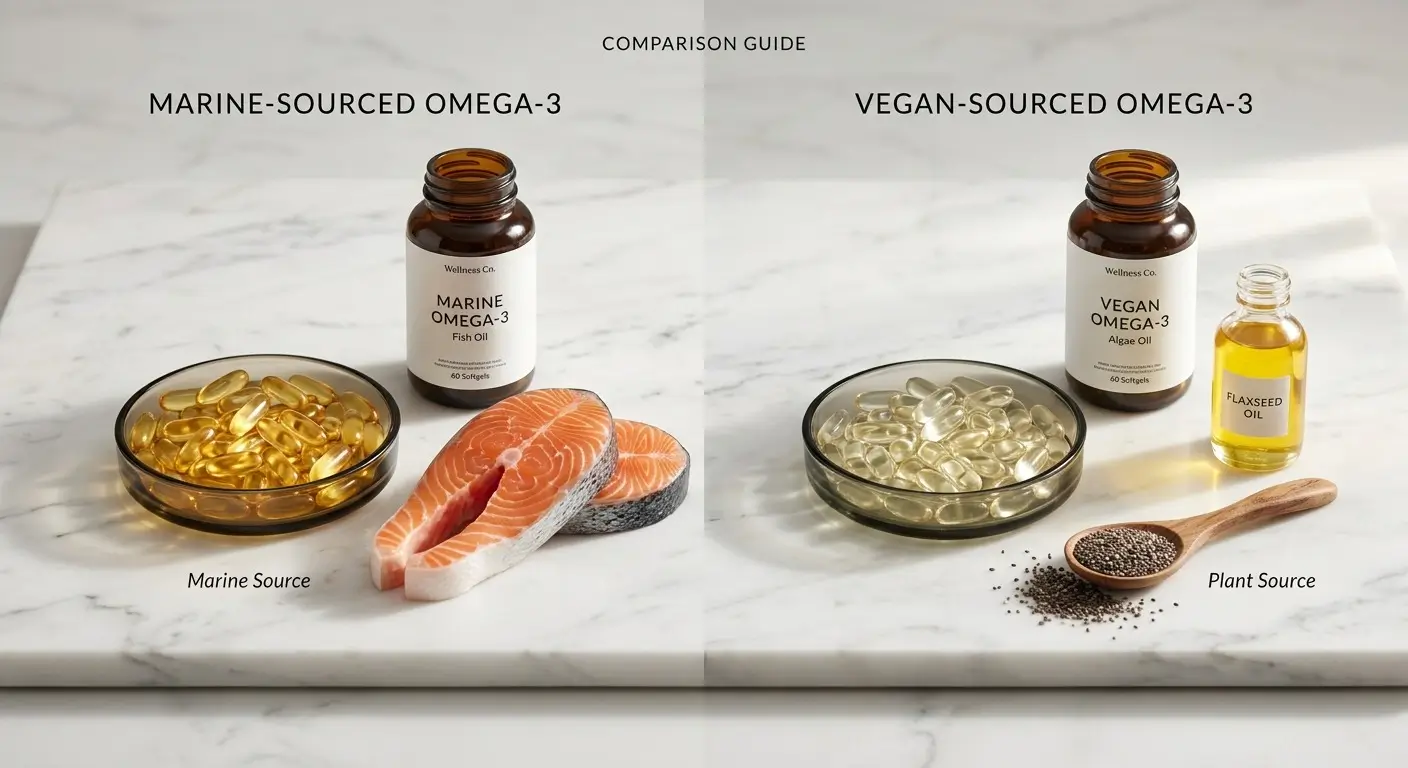

Fish Oil vs Plant Based Omega 3: Which Is Best for Your Health?
Before comparing sources, it’s essential to understand what omega-3 means, because omega-3 isn’t a single compound. It’s a family of fatty acids, and the differences among its members are significant.
The Three Types of Omega-3
- ALA (Alpha-Linolenic Acid)
ALA is the plant kingdom’s contribution to omega-3. Found in flaxseed, chia seeds, hemp seeds, walnuts, and certain vegetable oils, ALA is the most widely consumed omega-3 in vegetarian and vegan diets. This is the critical limitation: ALA is a short-chain omega-3. Your body cannot use it directly for the cardiovascular, neurological, and anti-inflammatory functions most people associate with omega-3 supplements. It must first be converted into the longer-chain EPA and DHA, and this conversion process is notoriously and consistently inefficient.
Research across multiple studies puts the conversion rate of ALA to EPA at roughly 5–10%. The conversion to DHA is even lower, often cited as 2–5% or less. The exact figure varies between individuals (women, particularly those of reproductive age, convert slightly more efficiently than men). Still, the general picture is consistent: the vast majority of ALA you consume is oxidised for energy rather than converted into the forms your brain and heart need.
- EPA (Eicosapentaenoic Acid)
EPA is a long-chain omega-3 fatty acid found in marine sources, principally oily fish, fish oil, and marine algae. Unlike ALA, EPA is biologically active without conversion. Your body uses it directly. EPA is the omega-3 most closely associated with cardiovascular health. It reduces blood triglycerides, manages vascular inflammation, supports arterial function, and has a meaningful evidence base for mood regulation and immune support. When the research talks about omega-3 protecting the heart, it is primarily talking about EPA.
- DHA (Docosahexaenoic Acid)
DHA is also a long-chain marine omega-3, and arguably the most structurally important of the three. It is incorporated directly into the phospholipid bilayer of cell membranes throughout the body, with particularly high concentrations in the brain (where it makes up around 40% of polyunsaturated fatty acids) and the retina. DHA is not simply a nutrient that passes through the body. It becomes part of your cellular architecture, influencing how efficiently neurons communicate, how well the retina processes visual information, and how effectively the skin barrier retains moisture. For cognitive health, visual function, foetal development, and skin quality, DHA is indispensable.
Fish Oil Omega 3
Fish oil is extracted from the tissue of oily fish, such as anchovies, sardines, mackerel, salmon, and herring, which are the most common sources. It provides both EPA and DHA in their pre-formed, biologically active state. No conversion required. No metabolic inefficiency to account for.
The bioavailability of fish oil omega-3 depends significantly on the molecular form the product uses:
- Natural Triglyceride (TG): The form in which omega-3 occurs naturally in fish tissue. Good bioavailability, particularly when taken with a fat-containing meal.
- Ethyl Ester (EE): A processed form produced during concentration. Cheaper to manufacture and the most common form of budget supplements. Bioavailability is approximately 70% of that of the natural triglyceride form, meaning you absorb meaningfully less of what’s on the label.
- Re-esterified Triglyceride (rTG): A premium form where ethyl esters are converted back to a triglyceride structure. It has the highest bioavailability of the three and is the form used in the best-quality supplements on the market.
The cardiovascular research on fish-derived EPA and DHA is the most extensive in nutritional science. The REDUCE-IT trial demonstrated significant reductions in major cardiovascular events with a high-dose EPA supplement. The GISSI-Prevenzione trial showed reduced cardiovascular mortality with an EPA+DHA supplement following a heart attack. Decades of cohort studies link higher marine omega-3 intake with reduced risk of heart disease, stroke, cognitive decline, and inflammatory conditions. When nutritional guidelines recommend omega-3 for heart health, they are referring to EPA and DHA from marine sources. This distinction matters when choosing a supplement.
Two legitimate concerns about fish oil are sustainability and contamination. Fish accumulate environmental pollutants, mercury, PCBs, and dioxins from the marine food chain, particularly larger predatory species.
Quality fish oil addresses both concerns:
- Molecular distillation removes contaminants to undetectable levels
- Third-party testing (IFOS certification is the gold standard) independently verifies purity
- MSC certification confirms fish are sourced from sustainable, responsibly managed fisheries
- Small fish species (anchovies, sardines) are lower in the food chain and accumulate fewer pollutants
A quality fish oil supplement, properly sourced and purified, is both safe and environmentally responsible.
Plant-Based Omega 3
Flaxseed, Chia, and Hemp Oil Supplements
These products provide ALA, the plant-form omega-3. They are widely marketed as omega-3 supplements, and while they do contain omega-3 fatty acids in a technical sense, their utility for the cardiovascular and cognitive outcomes most people are supplementing for is significantly limited by the conversion problem described above. For context: a 1,000mg flaxseed oil capsule might contain around 500mg of ALA. With a 5–10% conversion rate to EPA, that yields approximately 25–50mg of EPA, compared to the 500–1,000mg of EPA per serving in a quality fish oil capsule. For meaningful heart and brain health support, the arithmetic simply doesn’t work in favour of flaxseed-based supplements.
This doesn’t make them worthless. ALA has its own value; it contributes to overall fatty acid balance and provides some anti-inflammatory effect in its own right. But as a substitute for fish-derived EPA and DHA in the context of heart health, cognitive function, or anti-inflammatory support, the evidence is not supportive.
Algae-Based Omega-3
Marine microalgae are the source of omega-3 in the food chain. Fish don’t create EPA and DHA; they accumulate them by eating algae (directly or through other marine organisms). By supplementing with algae oil, you’re going straight to the source. Quality algae supplements provide preformed DHA, and increasingly, EPA as well, as formulation technology has improved. This completely bypasses the ALA conversion problem. The bioavailability of algae-derived DHA is comparable to that of fish oil, with studies showing similar blood DHA levels between algae and fish oil supplement groups.
Algae oil is the only plant-based omega-3 that can genuinely substitute for fish oil in terms of DHA delivery. For vegans, vegetarians, and those who prefer to avoid marine animal products, algae-based omega-3 is a well-evidenced choice, as Harvard nutrition research explains. Algae oil tends to be more expensive than fish oil, and while DHA content is typically strong, EPA content varies more between products. For cardiovascular health in particular, checking EPA levels is important when choosing an algae supplement.
Fish Oil vs Plant-Based Omega 3
| Fish Oil (rTG) | Fish Oil (EE) | Algae Oil | Flaxseed Oil | |
|---|---|---|---|---|
| Contains EPA | ✅ High dose | ✅ Moderate dose | ✅ Varies | ❌ ALA only |
| Contains DHA | ✅ High dose | ✅ Moderate dose | ✅ Strong | ❌ ALA only |
| Bioavailability | Highest | Moderate | High | Very low (conversion) |
| Requires conversion | ❌ No | ❌ No | ❌ No | ✅ Yes (inefficient) |
| Vegan | ❌ No | ❌ No | ✅ Yes | ✅ Yes |
Benefits for Heart Health
- Fish oil: Strong, extensive evidence. EPA directly reduces triglycerides, manages vascular inflammation, and supports arterial health. The research base is the deepest in nutritional science.
- Algae oil: Growing evidence, particularly for DHA. EPA content varies; check the label carefully for cardiovascular support.
- Flaxseed/ALA: Minimal direct cardiovascular benefit due to conversion inefficiency. Some population-level associations with reduced heart disease risk, but they are mechanistically weaker than direct EPA/DHA intake.
- Verdict: Fish oil or algae oil (EPA-containing formula) for heart health. Flaxseed oil is not an adequate substitute.
Benefits for Brain and Cognitive Function
- Fish oil: Excellent. DHA is structurally essential for neuronal function. Decades of research link fish oil supplements with improved memory, processing speed, mood, and reduced risk of cognitive decline.
- Algae oil: Comparable DHA delivery to fish oil. Strong evidence base for algae-derived DHA on cognitive outcomes, particularly maternal and infant brain development, where algae DHA is actually more commonly used in clinical settings.
- Flaxseed/ALA: Very limited. The minimal ALA-to-DHA conversion makes it an unreliable source for meaningful cognitive support.
- Verdict: Fish oil and quality algae oil are equivalent for brain health. Flaxseed oil is insufficient.
Benefits for Skin Health
- Fish oil: EPA reduces inflammatory skin conditions (eczema, psoriasis), improves barrier function, and supports hydration at the cellular level. DHA contributes to skin membrane integrity.
- Algae oil: DHA content supports skin membrane structure and hydration similarly to fish oil.
- Flaxseed oil: Some limited evidence for skin hydration via ALA; topically applied flaxseed oil may have modest benefits, but the oral supplement evidence for skin outcomes is weaker than for marine omega-3.
How to Choose the Right Omega-3
Choose Fish Oil If You:
- Are not vegan or vegetarian
- Want the most extensively researched form of omega-3
- Are prioritising cardiovascular health (especially EPA)
- Want the most cost-effective high-potency EPA + DHA option
- Prefer the widest choice of products and formulations
Choose Algae Oil If You:
- Are you vegan or vegetarian
- Prefer to avoid marine animal products
- Want comparable DHA delivery to fish oil without the fish
- Are you pregnant or breastfeeding and want a vegan DHA source
- Are environmentally motivated in supplement choices
Avoid Relying on Flaxseed/ALA Supplements If:
- Your goal is cardiovascular or cognitive health
- You need reliable EPA and DHA delivery
- You are using it as a substitute for fish or algae oil
Our Recommended Choice for Most Adults
For the majority of non-vegan adults, a high-quality fish oil supplement providing meaningful EPA and DHA remains the most practical, cost-effective, and evidence-backed choice for heart, brain, and overall health support. The Wellosophy Omega 3 Fish Oil Capsules deliver a well-dosed combination of EPA and DHA per serving, sourced from sustainable fisheries and purified through molecular distillation for heavy metal and contaminant removal. The formulation is clean, free from unnecessary additives, and transparent about its active content.
Conclusion
If you eat fish and want the most extensively researched, cost-effective route to adequate EPA and DHA for your heart, brain, and overall health, a high-quality fish oil is the straightforward recommendation. If you’re vegan, vegetarian, or simply prefer to avoid marine animal products, algae-based omega-3 is a genuinely excellent choice that delivers comparable DHA and increasing EPA content. If you’re relying on flaxseed or other ALA-based supplements as your primary omega-3 source, the evidence suggests you’re almost certainly not getting the EPA and DHA your cardiovascular and cognitive health requires. The Wellosophy Omega 3 Fish Oil Capsules offer a clean, transparent, and well-dosed option for adults who want fish-derived EPA and DHA they can rely on daily.
And if you’d like the complete article on omega-3, covering everything from deficiency signs and life-stage considerations to the full science of EPA, DHA, and ALA, our Complete Guide to Omega 3 Supplements for Heart, Brain and Overall Health is the most thorough resource we’ve published on the subject. .