

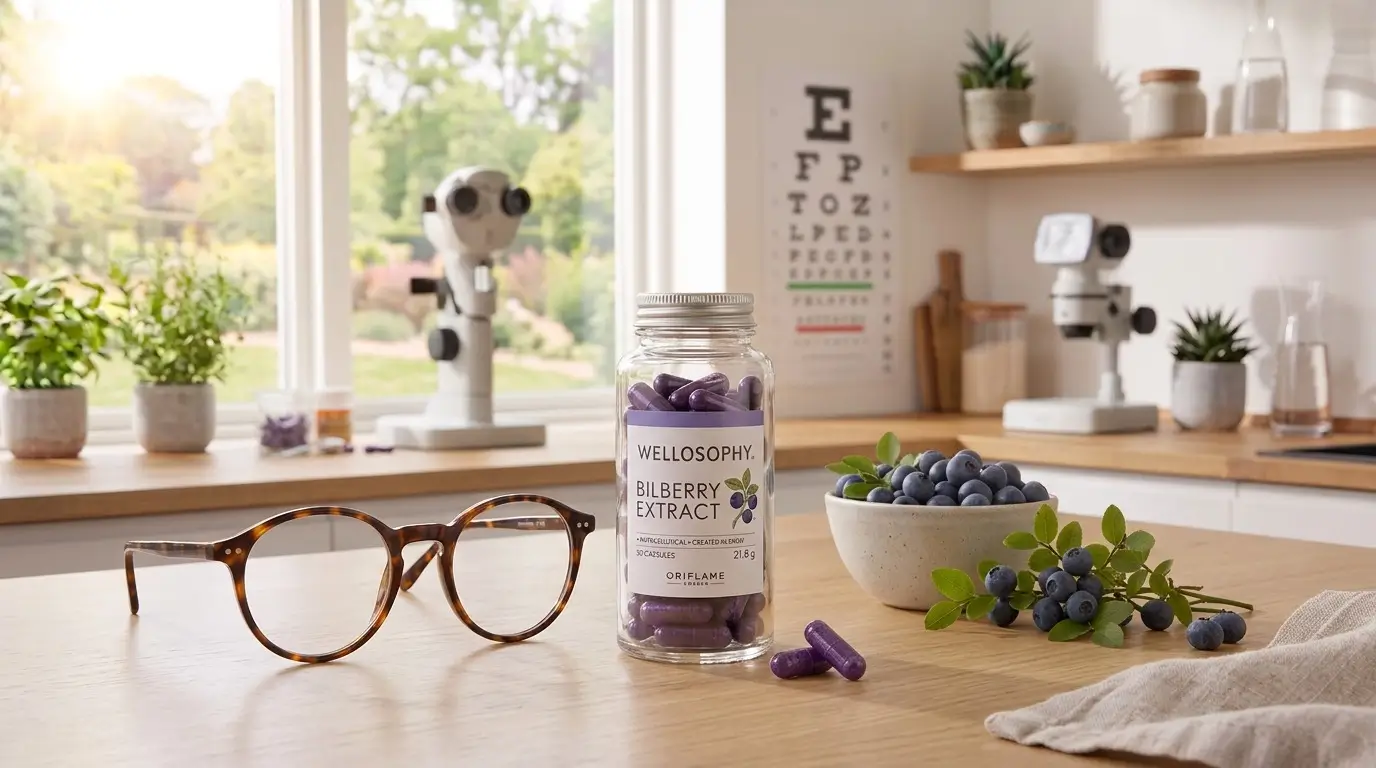

Bilberry Benefits for Eyes: Science, Eye Strain & Vision Support
Bilberry is a small, intensely pigmented berry that grows wild across Northern and Central Europe. Its deep blue-purple colour comes from exceptionally high concentrations of anthocyanins, a class of antioxidant flavonoids that are among the most potent plant-derived protective compounds studied in nutritional science. Bilberry extract is produced by concentrating and standardising these anthocyanins to a specific, measurable level, typically 25–36%, making supplements reliable and consistent in a way that simply eating berries cannot be.
For a complete guide to what bilberry is, where it comes from, and how it differs from blueberry, see our full article on what is bilberry extract and how it works.
Why Antioxidants Matter for Eye Health
- The Eye Under Oxidative Stress
The retina is one of the most metabolically demanding tissues in the entire body. It converts light into electrical signals continuously, a process that generates significant oxidative by-products. It is also directly exposed to light energy, including the high-energy visible (HEV) blue light emitted by digital screens. This combination- high metabolic demand and constant light exposure- means the retina produces more free radicals per gram of tissue than almost any other organ. Left unchecked, this oxidative activity damages photoreceptors, the cells that detect light, the retinal pigment epithelium (RPE), and the capillary network that sustains them. Over time, this accumulating damage contributes to age-related macular degeneration, cataracts, and declining visual function that become more common from the mid-50s onward.
- Blue Light and Screen Exposure
Blue light, the short-wavelength end of the visible light spectrum emitted prominently by LED screens, has attracted considerable attention in eye health research. It penetrates more deeply into the eye than longer wavelengths, reaching the retina directly, and generates oxidative stress in photoreceptors and RPE cells. Beyond the long-term concern, sustained exposure from prolonged screen use also disrupts the natural blink reflex; blinking rate can drop by up to 60% during screen work, reducing tear film stability and contributing to the dryness and surface irritation associated with digital eye strain.
- Ageing and the Eye
With age, the eye’s own antioxidant defences, including glutathione levels in the lens and antioxidant enzyme activity in the retina, decline. The accumulation of oxidative damage becomes progressively less well-managed. This is the primary driver of the age-related eye conditions that become more prevalent after 50: macular degeneration, cataracts, and declining contrast sensitivity. Supporting antioxidant status through diet and supplements becomes more important precisely as the eye’s own defences diminish.
Bilberry Benefits for Eyes
- Protection Against Oxidative Stress in the Retina
Bilberry anthocyanins accumulate in retinal tissue when supplemented consistently, a well-established finding that explains much of what follows. Once present in retinal and RPE cells, they provide direct antioxidant protection at the site of highest oxidative activity.
Research has demonstrated that bilberry anthocyanins:
- Neutralise the reactive oxygen species (ROS) generated by photoreceptor activity and light exposure
- Activate the Nrf2 pathway, a master switch for the body’s own antioxidant enzyme production, increasing internal antioxidant defences in retinal cells
- Protect mitochondria within retinal cells from oxidative damage, supporting the cellular energy production that visual processing requires
- Support for Retinal Health
The retinal pigment epithelium (RPE) is a single layer of cells beneath the photoreceptors that performs several essential maintenance functions, clearing photoreceptor debris, recycling visual pigments, and maintaining the blood-retinal barrier. RPE dysfunction is one of the primary early events in age-related macular degeneration. Bilberry has demonstrated specific protective effects on RPE cells in research, reducing the oxidative and inflammatory damage that compromises RPE function, and supporting the cellular integrity of these maintenance cells.
Again, bilberries’ effects on retinal capillary strength and permeability protect the vascular supply that keeps the retina nourished. The tiny blood vessels of the choroid, the vascular layer beneath the retina, are among the most vulnerable to oxidative and inflammatory damage in the eye, and bilberry’s well-established capillary-strengthening effects are directly relevant here.
- Relief From Digital Eye Strain
This is arguably the most practically relevant of the bilberry eye benefits for most people, and it has some of the most consistent clinical evidence. Digital eye strain, also called computer vision syndrome, produces a cluster of symptoms: tired, aching, or burning eyes; blurred or double vision; dryness and irritation; difficulty refocusing from near to far; and headaches, particularly behind the eyes or at the temples, as the American Academy of Ophthalmology explains.
Multiple randomised clinical trials have found that bilberry extract supplements significantly reduce digital eye strain symptoms. Key studies include:
- A randomised, double-blind, placebo-controlled trial in Japanese office workers found significant improvements in eye fatigue, eye pain, and heavy sensation after four weeks of bilberry supplements
- A clinical study in adults with high video display terminal (VDT) use found reductions in eye discomfort, blurred vision, and foreign body sensation with standardised bilberry extract at 160mg daily over 8 weeks
- Research in students showed reduced eye fatigue and improved visual acuity parameters after bilberry supplementation compared to a placebo
- Reduction of Eye Fatigue
Related to but distinct from digital eye strain, general eye fatigue- the sense of heaviness and tiredness in the eyes at the end of a long day- has also been specifically studied in relation to bilberry. Eye fatigue reflects the accumulated physiological cost of sustained visual work: ciliary muscle fatigue from prolonged focus, reduced tear film stability, and oxidative depletion in the visual processing pathway.
Studies specifically measuring eye fatigue parameters, including self-reported fatigue scales and objective measurements of accommodation, the eye’s ability to change focus, have found improvements with bilberry supplements compared to placebo. The accommodative amplitude, how much the eye can shift from near to far focus, and the speed of visual accommodation have both shown improvements in bilberry-supplemented groups in multiple trials.
- Support for Night Vision
Bilberry’s association with improved night vision has a long history; the WWII RAF pilot anecdote is often cited, perhaps with some embellishment, and the mechanistic basis is well-established even if the clinical evidence is more mixed. Rod photoreceptors, the cells responsible for low-light and peripheral vision, depend on a light-sensitive pigment called rhodopsin. When exposed to bright light, rhodopsin bleaches. In darkness, it regenerates, a process called dark adaptation. The speed of dark adaptation determines how quickly the eyes adjust from bright to dim environments.
Bilberry anthocyanins are believed to support rhodopsin regeneration, potentially speeding up dark adaptation. Some clinical trials have found improvements in dark adaptation time and night vision acuity with bilberry supplements, while others have found no significant effect. The inconsistency across studies may reflect differences in dosage, extract standardisation, and study population.
- Healthy Blood Circulation in the Eyes
The eye’s vascular health is fundamental to its function. The choroid, a dense network of capillaries beneath the retina, supplies the photoreceptors and RPE with oxygen and nutrients. Any compromise in this circulation degrades photoreceptor function and accelerates retinal ageing. Bilberry has demonstrated consistent effects on capillary integrity and microvascular circulation in research. By strengthening the walls of small blood vessels, reducing capillary permeability, and inhibiting the inflammatory mediators that damage vascular endothelium, bilberry supports the circulatory health that the retina depends on.
Bilberry and Screen Time
The relationship between prolonged screen use and eye health is straightforward: screens ask a great deal of the visual system in ways it wasn’t designed for.
- The blink problem: Normal blinking rate is approximately 15–20 times per minute. During screen use, this drops to 5–7 times per minute, insufficient to maintain the tear film that lubricates and protects the ocular surface.
- The near-focus fatigue: Sustained near-focus work keeps the ciliary muscles in a state of continuous contraction. Over hours, this produces the aching, heavy feeling behind the eyes that’s characteristic of screen fatigue.
- The oxidative load: Blue light from screens generates reactive oxygen species in retinal cells. Sustained daily exposure accumulates over the years.
Bilberry addresses the retinal oxidative stress and the circulatory support dimensions of this problem. It doesn’t fix blink rate or force ciliary relaxation, but by reducing the oxidative cost of sustained screen use on retinal tissue and improving the microcirculatory environment in which visual processing happens, it meaningfully reduces the strain that accumulates, as the American Academy of Ophthalmology explains.
For screen-heavy lifestyles, practical complementary approaches alongside supplements include:
- The 20-20-20 rule: every 20 minutes, look at something 20 feet away for 20 seconds
- Increasing blink frequency consciously during screen work
- Adjusting screen brightness and contrast to reduce glare
- Using blue light filter settings on devices during evening hours
Bilberry and Healthy Ageing Eyes
Age-related macular degeneration (AMD) is the leading cause of central vision loss in adults over 50 in the developed world. It develops over the years through the accumulation of oxidative damage in the macula, the central area of the retina responsible for detail and colour vision.
While bilberry has not been proven to prevent or treat AMD, the biological evidence for why it might help is sound:
- Accumulation of anthocyanins in macular tissue provides direct antioxidant protection where AMD damage begins
- RPE cell protection reduces the early cellular dysfunction that precedes AMD progression
- Capillary protection maintains the choroidal circulation on which RPE and photoreceptor health depend
- Anti-inflammatory mechanisms reduce the chronic retinal inflammation increasingly implicated in AMD development
Population-level data consistently show that higher dietary anthocyanin intake is associated with lower AMD prevalence, a correlation that is mechanistically plausible even if causality has not been established. Cataracts, the clouding of the crystalline lens, represent another major age-related eye condition. The lens is particularly vulnerable to oxidative damage because it has no blood supply and relies entirely on its own antioxidant systems. Bilberry’s antioxidant activity in lens tissue provides a degree of protection, though again, this is a preventive rather than therapeutic application.
Food Sources of Bilberry
| Source | Notes |
|---|---|
| Fresh bilberries | Seasonal (summer) available in Northern Europe, Scandinavia, and some UK regions |
| Dried bilberries | Year-round availability, retaining significant anthocyanin content |
| Bilberry jam and preserves | Widely available in Scandinavian and Eastern European countries |
| Bilberry juice | Available commercially; check for added sugar and anthocyanin content |
| Fresh wild-foraged bilberries | Common in Scandinavian and Baltic countries |
Bilberry Supplements for Eye Health
Choosing an effective bilberry supplement for eye health requires attention to a few key quality markers:
- Standardised Anthocyanin Content
This is the most critical factor. Look for a supplement standardised to 25–36% anthocyanins, the concentration range used in clinical research. Without standardisation, the active compound content is undefined and potentially inconsistent between batches. A product listing “bilberry extract” without specifying the anthocyanin percentage may contain negligible levels of active compounds despite the name on the label.
- Recommended Dosage
Most clinical research on bilberry for eye health has used:
- 80–160mg daily of standardised extract 25% anthocyanins, the range most commonly used in digital eye fatigue trials
- Up to 480mg daily in more intensive clinical settings
Follow the product’s label instructions, which will be calibrated to the specific extract’s concentration. Consistency matters more than the exact timing; daily intake over weeks builds the tissue levels that drive results.
- Quality Considerations
- Clearly stated standardised anthocyanin percentage on the label
- Berry-derived extract is the most studied form rather than leaf-derived
- No unnecessary fillers, artificial colours, or preservatives
- Third-party purity testing is available
- Combination Products
Bilberry for eye health is increasingly combined with astaxanthin, another antioxidant with specific retinal accumulation properties. The rationale for this combination is strong: both compounds reach ocular tissue, but through different mechanisms and with different specific protective effects. Together, they provide broader retinal antioxidant coverage than either alone.
Recommended Product
Wellosophy Astaxanthin & Bilberry Extract
For eye health specifically, the Wellosophy Astaxanthin & Bilberry Extract combines the two most clinically relevant antioxidants for retinal and ocular tissue in a single daily product.
Bilberry contributes capillary-strengthening effects in the retinal vasculature, anthocyanin-based antioxidant protection in retinal tissue, support for dark adaptation, and the specifically documented reductions in digital eye fatigue symptoms supported by multiple clinical trials.
Astaxanthin adds a complementary dimension: it crosses the blood-retinal barrier directly, providing antioxidant protection specifically within photoreceptors and retinal tissue at a potency estimated to be significantly higher than most other antioxidants. Its anti-inflammatory effects reduce the oxidative-inflammatory cascade in retinal tissue that both blue light and age-related degeneration drive.
Bilberry’s vascular and capillary protective effects, combined with astaxanthin’s direct intracellular retinal antioxidant activity, provide two distinct protective mechanisms operating at different levels of ocular anatomy. The combination is more comprehensive than either ingredient alone for long-term eye health support.
Conclusion
The eyes are among the most metabolically demanding and oxidatively stressed organs in the body, and in the digital age, that stress has increased substantially. The evidence that bilberry extract supports eye health through multiple complementary mechanisms- antioxidant protection in retinal tissue, capillary strengthening, and reduction of digital eye strain is more consistent and well-researched than most botanical eye supplements can claim. Choose a standardised extract of 25–36% anthocyanins, take it daily with food, and consider pairing it with astaxanthin for the broadest possible retinal antioxidant coverage. The Wellosophy Astaxanthin & Bilberry Extract provides both in one product.