

Bilberry Extract (Vaccinium myrtillus): The Ultimate Guide
Bilberry, Vaccinium myrtillus, is a small, dark-blue berry that grows wild across Northern and Central Europe, parts of Asia, and some regions of North America. It’s a close relative of the American blueberry; both belong to the Vaccinium genus, but the two are botanically and nutritionally distinct. Bilberry grows as a low-lying shrub, typically in forests and moorland, and produces small, dark berries that are intensely pigmented, so much so that they stain your teeth and fingers deep purple-blue when eaten fresh.
The extract used in supplements is made from the ripe berries or sometimes the leaves, though berry extracts are more commonly used and better studied. The extraction process concentrates the active compounds, primarily anthocyanins, to a standardised level that makes supplements predictable and measurable.
Anthocyanins: The Active Compounds
The health benefits of bilberry are primarily attributed to its exceptionally high anthocyanin content. Anthocyanins are a class of flavonoid pigments responsible for the deep blue, purple, and red colours in many fruits and vegetables, and they’re among the most potent antioxidant compounds in the plant kingdom, as research published in the National Library of Medicine shows. Bilberry contains a particularly diverse and concentrated mixture of anthocyanins, with up to 15 different anthocyanin compounds identified in the berry. This diversity is thought to contribute to a broader spectrum of antioxidant activity than foods with fewer anthocyanin types. Quality bilberry extracts are standardised to contain a specific percentage of total anthocyanins, typically 25–36%.
What Is the Difference Between Bilberry vs Blueberry?
Both bilberry and blueberry are from the same genus and share some similar compounds. But bilberry generally has a higher anthocyanin concentration; some analyses find bilberry contains roughly four times the anthocyanin levels of commercial blueberries. Bilberry’s anthocyanins are also distributed throughout the entire flesh of the berry, which is why it stains so deeply, while blueberries have most of their pigment concentrated in the skin. Again, the specific anthocyanin profile differs between the two; bilberry contains delphinidin, cyanidin, petunidin, peonidin, and malvidin glycosides, while blueberry’s profile is similar but not identical in its ratios. For supplement purposes, standardised bilberry extract provides a more concentrated and consistent dose of active compounds than blueberry extract.
How Bilberry Extract Works in the Body
Bilberry’s primary mechanism of action is antioxidant, neutralising the free radicals that cause oxidative damage to cells, proteins, and DNA. But anthocyanins do more than just neutralise free radicals. Research has identified several additional mechanisms:
- Anti-inflammatory activity: Bilberry anthocyanins inhibit several pro-inflammatory pathways, reducing the production of inflammatory cytokines and modulating NF-κB signalling, a key regulator of the inflammatory response.
- Vascular protection: Bilberry has demonstrated specific protective effects on blood vessel walls, strengthening capillary integrity, reducing permeability, and improving microvascular circulation. This vascular mechanism is directly relevant to eye health, where the retina depends on a dense capillary network, and to skin health, where microcirculation determines nutrient delivery to skin cells.
- Collagen stabilisation: Anthocyanins have been shown to inhibit the enzymes that degrade collagen (collagenase) and elastin (elastase), protecting the structural proteins of skin and vascular walls.
- Blood sugar regulation: Some research suggests bilberry may improve insulin sensitivity and modulate blood glucose levels, mechanisms that also indirectly benefit skin health by reducing the glycation-driven collagen damage that accelerates skin ageing.
Bilberry Extract Benefits
- Eye Health
This is the area of bilberry research with the longest history and the most accumulated clinical evidence. Bilberry’s reputation for eye health dates to World War II, when British Royal Air Force pilots reportedly consumed bilberry jam before night missions, claiming it improved their night vision, as research published in the National Library of Medicine shows.
Night vision and adaptation: Several studies have found that bilberry supplements improve dark adaptation, the ability of the eyes to adjust from bright to dim light. This is thought to reflect bilberry’s support of rhodopsin regeneration in rod photoreceptors.
Retinal protection: Bilberry anthocyanins accumulate in retinal tissue and provide antioxidant and anti-inflammatory protection to photoreceptors and the retinal pigment epithelium. Population studies have linked higher anthocyanin intake with reduced risk of age-related macular degeneration.
Digital eye strain: Multiple clinical trials have found that bilberry extract supplements significantly reduce the symptoms of digital eye strain, including fatigue, dryness, blurred vision, and discomfort in people spending extended hours in front of screens. This is one of the most practical and immediately relevant benefits for most working adults.
- Skin Health
Bilberry’s combination of antioxidant activity, anti-inflammatory properties, and collagen-protective mechanisms makes it directly relevant to skin health, though this is an area where much of the evidence is still developing.
Antioxidant skin protection: The anthocyanins in bilberry neutralise free radicals that damage skin cells, including the UV-induced and pollution-driven oxidative stress that accelerates visible skin ageing.
Collagen and elastin preservation: By inhibiting collagenase and elastase, bilberry anthocyanins protect the structural proteins that keep skin firm and elastic, addressing the same mechanism that contributes to fine lines and loss of skin density with age.
Improved microvascular circulation to the skin: Better capillary integrity and circulation means better delivery of oxygen and nutrients to skin cells, supporting the cellular repair and renewal processes that determine how skin looks and recovers.
Brightening potential: Some research suggests anthocyanins can inhibit melanin overproduction, the mechanism behind dark spots and uneven skin tone.
- Cardiovascular and Circulatory Health
Bilberry’s vascular protective mechanisms extend beyond the retina to the broader cardiovascular system. Research has found associations between bilberry consumption and improvements in blood pressure, lipid profiles, and endothelial function, the ability of blood vessel walls to dilate and contract properly in response to blood flow demands. These effects are thought to reflect a combination of anthocyanins’ direct vascular effects and their indirect benefits through oxidative stress and inflammation reduction. Bilberry also demonstrates anti-platelet activity in some research, reducing the stickiness of platelets, which contributes to healthy blood flow and may reduce cardiovascular risk.
- Antioxidant Protection
As discussed, bilberry’s concentrated anthocyanin profile provides broad-spectrum antioxidant protection that extends across multiple tissue types. Anthocyanins are distributed throughout the body and have been detected in brain tissue, eye tissue, vascular walls, and skin, reflecting their multi-system protective reach.
- Healthy Ageing
The same oxidative and inflammatory mechanisms that bilberry addresses are primary drivers of biological ageing, the gradual accumulation of cellular damage that determines how well organs and tissues function with age. Regular anthocyanin intake from dietary and supplemental bilberry provides ongoing antioxidant maintenance across the cellular systems where this damage accumulates.
- Brain Health
Because bilberry anthocyanins can cross the blood-brain barrier, they directly reach neural tissue and provide antioxidant and anti-inflammatory protection within the brain. Animal and early human research has found associations between bilberry consumption and improved memory, learning, and cognitive performance, particularly in older adults.
Bilberry Extract for Eye Health
The retina is one of the most metabolically active and oxygen-demanding tissues in the body. It relies on a dense capillary network for nutrient delivery and generates significant oxidative stress as a by-product of its continuous activity, particularly in the photoreceptors that process light signals.
Bilberry anthocyanins support retinal health through three converging mechanisms:
- Direct antioxidant protection in retinal cells and the retinal pigment epithelium (RPE), the layer of cells beneath the photoreceptors that maintains their function and health.
- Capillary integrity and microvascular support: the retina’s capillary network is vulnerable to oxidative and inflammatory damage. Bilberry strengthens the walls of these small vessels, reducing leakage and supporting the consistent nutrient delivery the retina requires.
- Rhodopsin synthesis support. Rhodopsin is the light-sensitive pigment in rod photoreceptors responsible for low-light and peripheral vision. Some research suggests bilberry supports rhodopsin regeneration, contributing to improved dark adaptation.
Bilberry Extract for Skin
Bilberry’s skin benefits work primarily through the antioxidant and vascular mechanisms described above, but they’re worth exploring in practical terms.
- Protecting skin from the inside: Antioxidants provide surface protection. Bilberry’s anthocyanins, absorbed through supplements and distributed systemically, protect skin cells at the membrane and DNA level, reaching the dermis in ways that products generally cannot.
- Collagen network preservation: By inhibiting the enzymes that degrade collagen (collagenase) and elastin (elastase), bilberry helps maintain the structural matrix of the dermis. The practical effect of consistent supplementation is skin that loses its firmness and elasticity more slowly.
- Improved skin microcirculation: Skin that’s well-perfused with blood looks different from skin that isn’t, more evenly toned, more luminous, and healthier in texture. Bilberry’s vascular protective effects support the microcirculation that delivers these benefits.
- Anti-inflammatory effects on skin: Acne, redness, eczema, and the general reactivity of sensitive skin all have inflammatory components. Bilberry’s anti-inflammatory properties reduce the systemic inflammatory environment that drives these conditions.
Food Sources of Bilberry
Bilberries are primarily consumed in Scandinavian, Baltic, and Eastern European diets, where they’re available as fresh berries during summer and as jams, juices, and dried fruits year-round.
Natural dietary sources:
- Fresh bilberries seasonal, primarily in Northern and Central Europe
- Dried bilberries
- Bilberry jam and preserves
- Bilberry juice
- Wild-foraged bilberries common in Scandinavia, Finland, and the Baltic states
For most people outside these regions, fresh bilberries are rarely available, and commercial products may not contain standardised concentrations of anthocyanins. This is why supplementing with standardised bilberry extract, where the anthocyanin content is measured and guaranteed, is the most reliable approach for achieving consistent therapeutic intake. Other anthocyanin-containing foods that provide some similar benefits, though in different concentrations and profiles, are blueberries, blackcurrants, elderberries, blackberries, cherries, and red cabbage.
Bilberry Supplements
- Standardised Extract
The most important quality marker for a bilberry supplement is standardisation, specifically, the percentage of anthocyanins guaranteed per serving. Look for products standardised to 25–36% anthocyanins, which is the concentration range used in most clinical research.
Products that list bilberry without specifying the standardised anthocyanin content may contain inconsistent or insufficient levels of the active compounds.
- Dosage
Most clinical research on bilberry’s benefits has used doses of:
- 80–160mg daily of standardised extract 25–36% anthocyanins for general eye health and antioxidant support
- 160–480mg daily for more targeted support in clinical trial settings
The appropriate dose depends on the specific benefit being sought and the concentration of the extract. Follow product label instructions, which will be calibrated to the specific extract’s anthocyanin content.
- Quality Considerations
- Choose supplements from brands that publish their standardisation percentage clearly
- Look for products that specify the plant part used. Berry extract is more studied than leaf extract
- Third-party testing for purity adds further reassurance
- Bilberry pairs well with complementary antioxidants, particularly astaxanthin, which amplifies the eye health benefits through a distinct but complementary mechanism
Is Bilberry Extract Safe?
For most healthy adults, bilberry extract at standard supplement doses is well-tolerated and considered safe. Bilberry has a long history of food use across Northern Europe; fresh and preserved bilberries have been consumed for centuries. The extract form is similarly well-established, with no serious adverse effects reported in clinical studies using typical doses.
Specific considerations:
- Pregnancy and breastfeeding: Bilberry as a food is generally considered safe. Concentrated extract at supplement doses lacks sufficient safety data for these groups, and healthcare professional guidance is appropriate.
- Children: Adult supplement doses are not designed for children. Medical supervision is appropriate for supplements in young people.
- Upcoming surgery: Bilberry’s antiplatelet properties mean it could theoretically increase bleeding risk during surgery. Standard practice is to stop herbal supplements 1–2 weeks before elective surgical procedures.
- People with hypoglycaemia: Given bilberry’s potential blood glucose-lowering effects, people with hypoglycaemia or those on diabetes medications should monitor blood sugar carefully and discuss bilberry supplements with their doctor.
Bilberry Side Effects
At typical supplement doses, bilberry extract is generally very well tolerated. Reported side effects are mild and uncommon:
- Mild digestive discomfort: Occasionally reported when first starting supplements, typically resolving with consistent use. Taking with food reduces this.
- Loose stools: At higher doses, the tannin content in bilberry may have mild astringent effects.
- Skin discolouration: At very high intakes primarily from large amounts of fresh berries rather than standard supplements, the deep pigment can temporarily stain the skin around the mouth or fingers.
Medication interactions:
- Anticoagulants and antiplatelet drugs: Bilberry’s antiplatelet properties could enhance the effect of blood thinners. People taking warfarin, aspirin therapeutically, or other anticoagulants should inform their prescribing doctor before supplementing.
- Diabetes medications: Potential additive blood glucose-lowering effects. Monitor blood sugar and inform your healthcare provider.
- Chemotherapy agents: There is a theoretical interaction potential; cancer patients should consult their oncologist before using bilberry supplements.
Recommended Product
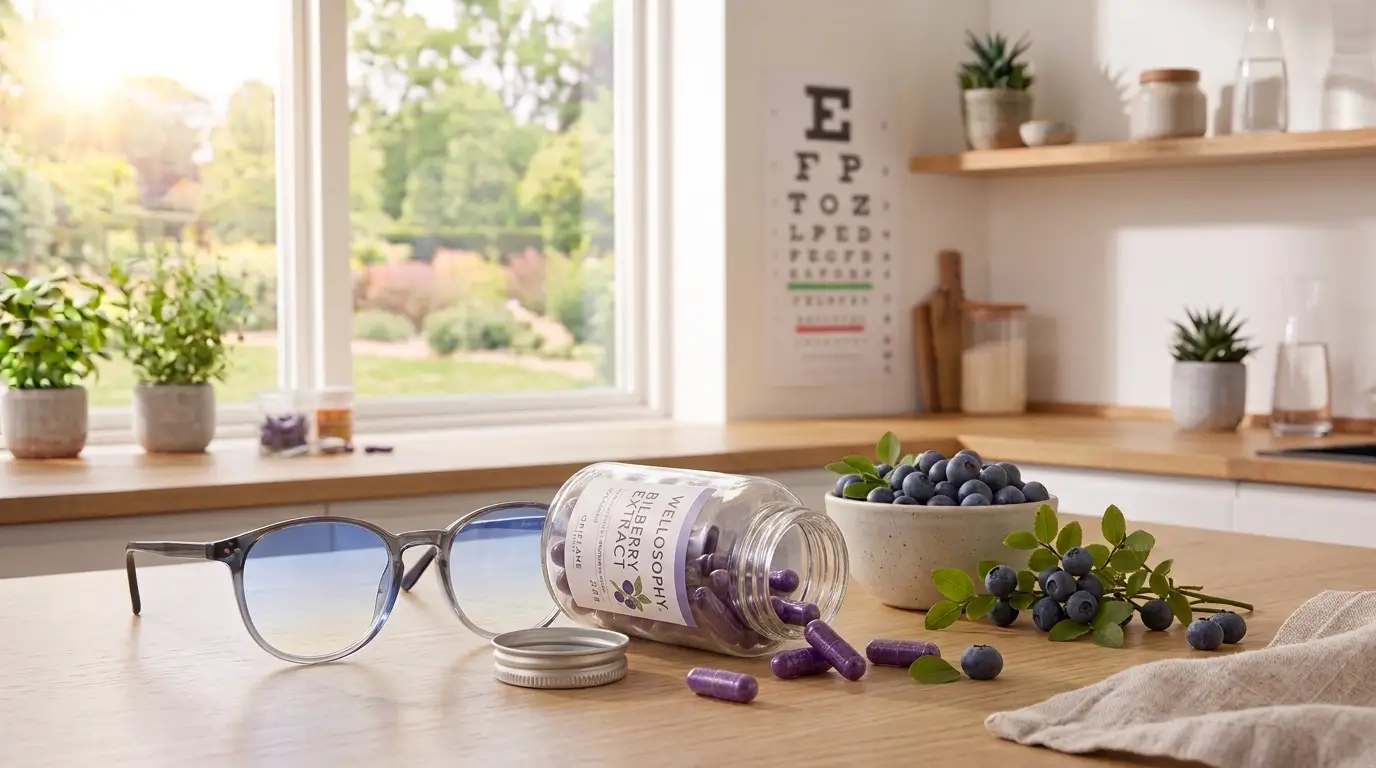
Wellosophy Astaxanthin & Bilberry Extract
At ZenithKind, we recommend the Wellosophy Astaxanthin & Bilberry Extract for people interested in the antioxidant, eye health, and skin benefits that bilberry and astaxanthin together can provide. The combination is deliberately chosen rather than arbitrarily assembled. Here’s why the two compounds work well together:
- Complementary eye health mechanisms: Astaxanthin crosses the blood-retinal barrier and provides direct antioxidant protection to retinal photoreceptors and the lens. Bilberry anthocyanins support capillary integrity in retinal vasculature and contribute to rhodopsin regeneration. Together, they address eye health through different, non-overlapping pathways that amplify each other’s protective effects.
- Broader antioxidant coverage: Astaxanthin is an exceptionally potent single-compound antioxidant that spans cell membranes. Bilberry provides a diverse mixture of anthocyanins with their own specific anti-inflammatory, vascular-protective, and collagen-preserving mechanisms. The two together provide a broader spectrum of antioxidant and cellular protective activity than either alone.
- Skin protection from multiple angles: Astaxanthin’s MMP-inhibiting and UV-protective effects, combined with bilberry’s collagenase inhibition and microvascular support, address skin ageing through more mechanisms simultaneously than a single antioxidant ingredient.
Conclusion
For eye health in particular, bilberry is one of the most consistently supported botanical options available. For skin health, antioxidant protection, and healthy ageing support, its diverse anthocyanin profile provides mechanisms that complement other antioxidants rather than duplicating them. The key, as with any supplement, is choosing quality. Look for standardised extracts with a clearly stated anthocyanin percentage, from brands that are transparent about their formulation. And consider whether a combination product, like bilberry alongside astaxanthin, might address your health concerns more comprehensively.