

Astaxanthin Benefits for Men: Skin, Heart, Stamina & Sperm Quality
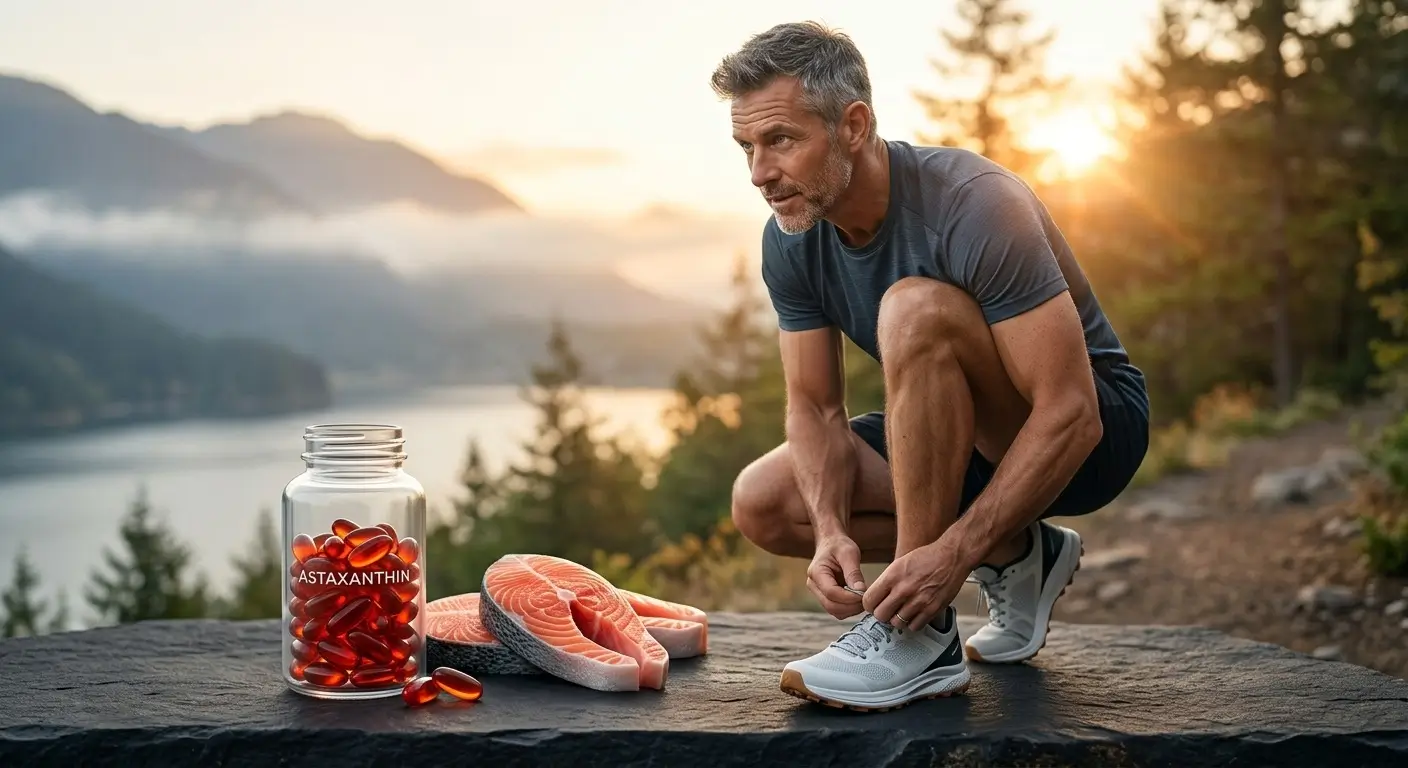
Astaxanthin is a natural pigment produced by a freshwater microalga called Haematococcus pluvialis. When this alga is exposed to intense sunlight or environmental stress, it generates astaxanthin to protect itself from oxidative damage. It’s the same compound that makes wild salmon, shrimp, lobster, and flamingos pink.
In supplement form, it’s typically extracted from Haematococcus pluvialis algae, the most concentrated natural source, rather than derived from seafood. What makes it stand out among antioxidants is a combination of potency and structural versatility. Its molecular architecture allows it to span the full width of a cell membrane, protecting both the inside and outside simultaneously, something most antioxidants can’t do. Estimates of its free radical neutralisation capacity suggest it is roughly 6,000 times more potent than vitamin C and 800 times more potent than CoQ10, though in practice it complements rather than replaces other antioxidants in a daily routine.
It can also cross the blood-brain barrier and the blood-retinal barrier, making it directly available to the brain and eyes in a way that most antioxidants are not. Read our complete guide on What is Astaxanthin and how does it work.
Astaxanthin Benefits for Men
- Powerful, System-Wide Antioxidant Protection
The most fundamental benefit is the one that underpins everything else. Oxidative stress, the accumulation of cellular damage caused by free radicals, is influenced by exercise, diet quality, sleep deprivation, chronic psychological stress, environmental pollutants, and UV exposure. Men who train hard, work long hours, eat inconsistently, or spend significant time outdoors are generating a higher oxidative load than most of us acknowledge. Astaxanthin provides antioxidant protection across multiple tissue types simultaneously. It protects cell membranes, mitochondrial function, cardiovascular tissue, neural tissue, retinal cells, and skin, all in a single daily compound. Most antioxidants target one system well. Astaxanthin covers several at once.
- Skin Health and UV Damage Protection
Men’s skincare gets less attention than women’s, but the biology is identical. Collagen breaks down at roughly the same rate. UV damage accumulates the same way. The oxidative stress that degrades skin structure doesn’t discriminate. The difference is that most men don’t address this at all, meaning astaxanthin often has more ground to cover and more visible impact for men who do take it.
Collagen protection: Astaxanthin inhibits matrix metalloproteinases (MMPs), the enzymes triggered by UV exposure and oxidative stress that break down collagen and elastin. This slows the structural degradation of skin that leads to lines, rough texture, and loss of firmness.
UV cellular defence: Astaxanthin accumulates in skin cells and reduces UV-induced DNA damage and the inflammatory response following sun exposure. For men who spend significant time outdoors, whether through work, sport, or general activity, this internal cellular protection complements whatever SPF they may or may not be applying.
Improved skin hydration: The barrier function of the skin depends on the quality of the lipid structure of cell membranes. Astaxanthin strengthens membrane integrity, improving the skin’s ability to retain moisture. Men who deal with persistently dry or rough skin texture often see genuine improvement here.
Reduced skin redness and irritation: Astaxanthin’s anti-inflammatory properties reduce the reactive skin responses that show up as redness and uneven tone, particularly relevant for men with sensitive or easily irritated skin.
- Exercise Recovery and Muscle Support
This is where many men first encounter astaxanthin, and it’s probably the most practically immediate benefit for anyone who trains regularly, according to PubMed on exercise recovery.
Reduced oxidative muscle damage: Exercise generates significant oxidative stress in muscle tissue. Astaxanthin’s antioxidant activity at the cell membrane level reduces the extent of this damage, supporting faster cellular recovery between sessions.
Decreased muscle soreness: Multiple clinical trials have found measurable reductions in delayed onset muscle soreness (DOMS) and markers of muscle inflammation in men supplementing with astaxanthin during training programmes. Less soreness between sessions means better training consistency.
Endurance support: A well-cited study in trained male cyclists found significant improvements in power output and time to exhaustion after four weeks of astaxanthin supplement intake compared to placebo. The proposed mechanism involves improved fat oxidation. Astaxanthin may support the body’s ability to use fat as a fuel source during sustained aerobic effort, sparing glycogen and extending performance.
Preservation of muscle function under fatigue: Research has also suggested that astaxanthin may help preserve muscle contractile function under conditions of fatigue-induced oxidative stress, particularly relevant for men training at high intensity or volume.
- Eye Health and Digital Eye Strain
For men spending extensive time in front of screens, whether for work, gaming, or general use, digital eye strain is a real and growing concern. Astaxanthin is one of the few antioxidants that can cross the blood-retinal barrier, meaning it accumulates directly in the retinal and lens tissue of the eye.
Reduced eye fatigue: Several clinical trials have found that 6 mg of astaxanthin daily produces significant reductions in eye strain, eye fatigue, dryness, and discomfort from screen use within 4–8 weeks.
Improved visual acuity: Some research has found improvements in visual accommodation, the eye’s ability to adjust focus rapidly between distances, with consistent astaxanthin use.
Long-term retinal protection: Astaxanthin’s accumulation in the macula provides antioxidant defence against the oxidative damage associated with age-related macular degeneration, one of the leading causes of vision loss in men over 50.
- Heart Health Support
Cardiovascular disease is the leading cause of death among men globally, and it develops silently over years of accumulated oxidative and inflammatory damage to the vascular system.
LDL oxidation inhibition: LDL cholesterol doesn’t become dangerous simply because it’s elevated; it becomes dangerous when it’s oxidised. Oxidised LDL is the form that deposits into arterial walls and contributes to atherosclerosis. Astaxanthin has demonstrated significant inhibitory effects on LDL oxidation in human clinical studies.
Reduced vascular inflammation: Chronic vascular inflammation is the primary driver of arterial plaque progression. Astaxanthin reduces inflammatory markers, including CRP (C-reactive protein) and IL-6, directly relevant to cardiovascular risk management.
Improved blood flow and viscosity: Some studies have found improvements in blood viscosity, thickness, and microvascular circulation with astaxanthin supplements, supporting more efficient delivery of oxygen to tissues throughout the body.
For men over 35 who haven’t yet thought seriously about cardiovascular nutrition, astaxanthin alongside omega-3 is one of the most evidence-backed natural supplements to take daily.
- Healthy Ageing and Cellular Protection
Cellular ageing, the gradual accumulation of oxidative damage to DNA, proteins, and cell membranes, determines how well every system in the body continues to function as the decades pass.
Mitochondrial protection: Mitochondria, the energy-producing organelles in every cell, are among the most vulnerable to oxidative damage. Astaxanthin’s presence in mitochondrial membranes provides direct protection that supports both cellular energy production and the broader tissue function that mitochondrial health determines.
DNA protection: Astaxanthin has demonstrated protective effects against oxidative DNA damage in several studies, relevant for men who want to maintain cellular integrity into their 50s and beyond.
Neuroprotection: Crossing the blood-brain barrier gives astaxanthin direct access to neural tissue, providing antioxidant defence within the brain that supports the cognitive function, processing speed, and memory that gradually come under increased oxidative stress with age.
- Daily Wellness Support
Beyond the specific systems above, consistent astaxanthin use supports the general oxidative environment that determines how resilient men feel day to day, how well they recover from poor sleep, how consistently their energy holds, and how their immune function responds to the daily challenges of demanding modern life.
Astaxanthin and Active Men
For men who train regularly, the exercise recovery benefits deserve their own attention because they go beyond basic antioxidant support. Training creates a physiological stress that is, in part, oxidative. This is necessary because the inflammatory and oxidative response to exercise is part of what drives adaptation. But when oxidative stress from training exceeds the body’s recovery capacity, it leads to accumulated muscle damage, persistent fatigue, reduced performance across training cycles, and higher injury susceptibility. Astaxanthin doesn’t suppress the adaptive response to training; it reduces the excessive oxidative damage that doesn’t contribute to adaptation but does extend recovery time.
Studies have specifically measured this in men, finding:
- Reductions in serum creatine kinase, a marker of muscle cell damage after high-intensity exercise
- Lower interleukin-6 and other inflammatory cytokines post-exercise
- Faster restoration of muscle function after eccentric exercise
- Improved maintenance of power output across repeated exercise bouts
Astaxanthin for Men’s Skin
Men’s skin tends to be approximately 25% thicker than women’s, with more collagen density and higher sebum production, which provides some natural advantages. But the same underlying processes that affect skin in women affect men too, just with slightly different timelines and presentations.
Collagen maintenance: Men lose collagen at a similar rate to women until menopause, at which point women’s rate temporarily accelerates. But by the time most men in their 40s and 50s start noticing skin changes, rougher texture, deeper lines, loss of the firmness they had at 30, years of accelerating oxidative damage have already been doing their work. Astaxanthin’s MMP-inhibiting and fibroblast-protecting properties address this directly.
Post-shave skin health: The daily mechanical stress of shaving, combined with any alcohol-containing aftershaves or products, creates a recurring barrier disruption and minor inflammatory cycle. Astaxanthin’s anti-inflammatory properties provide a systemic support layer that helps the skin’s recovery from this daily routine.
Sun-exposed skin: Men are statistically less likely to use SPF consistently and more likely to have occupational or recreational outdoor exposure. The cumulative UV damage this creates is a primary driver of rough skin texture, pigmentation, and early loss of elasticity. Astaxanthin’s cellular UV protection addresses the damage at its source.
Food Sources of Astaxanthin
| Food | Notes |
|---|---|
| Wild sockeye salmon | The richest fish source, farmed salmon contains significantly less |
| Rainbow trout (wild) | Moderate natural levels |
| Red sea bream | Present in wild-caught varieties |
| Shrimp and prawns | Consistent levels across varieties |
| Lobster | Particularly concentrated in the shell area |
| Krill | Very rich source, primarily via krill oil |
Choosing an Astaxanthin Supplement
- Natural vs Synthetic
Always choose natural astaxanthin from Haematococcus pluvialis microalgae. Human clinical research on exercise recovery, cardiovascular health, skin elasticity, and eye health has been conducted using natural astaxanthin. Synthetic astaxanthin, produced chemically for aquaculture use, has a different stereoisomer profile and hasn’t been studied the same way for human health applications, according to EFSA research on the natural astaxanthin from Haematococcus pluvialis.
- Oil-Based Softgel Format
Astaxanthin is fat-soluble. In a dry powder capsule without an oil component, absorption is significantly lower than in an oil-based softgel. Look for products that use a softgel format with an oil base; this is not optional for meaningful bioavailability.
- Recommended Dosage
- 4–6mg daily: Well-supported for skin health, eye health, and general antioxidant support
- 6–12mg daily: Commonly used in exercise recovery and cardiovascular research
- Take with food: A meal containing healthy fat, eggs, fish, olive oil, and avocado improves absorption further
- Safety
Astaxanthin is well-tolerated at standard doses of 4–12mg daily. Men taking blood pressure medications or anticoagulants should mention astaxanthin to their doctor before starting, as there are mild potential interactions worth noting. For most healthy adult men, it’s considered safe for daily long-term use.
Our Recommended Product
The product we recommend at Zenithkind for men is the Wellosophy Astaxanthin & Bilberry Extract, a combination formula that brings together natural astaxanthin and bilberry extract in an oil-based softgel.
Natural astaxanthin covers the primary benefits covered in this article: cellular antioxidant protection, skin health, exercise recovery support, cardiovascular protection, and eye health.
Bilberry extract adds a complementary antioxidant dimension; bilberries are exceptionally rich in anthocyanins, which have their own clinical evidence for eye health, particularly reducing screen-related eye fatigue and supporting retinal microcirculation and general antioxidant support.
Conclusion
The astaxanthin benefits for men span several of the most significant health concerns men face: oxidative damage from training, cardiovascular risk, skin ageing, eye strain, and the general cellular decline that determines how well the body holds up over the long term. It’s not a quick fix or a dramatic intervention. It’s a daily antioxidant that, taken consistently in the right form and at the right dose, provides system-wide cellular protection that accumulates into meaningful health outcomes over months and years. For men who train regularly, spend time outdoors, spend hours in front of screens, or simply want a well-evidenced foundation for long-term wellness, astaxanthin is among the most clinically supported options available in the supplement category.