

Best Astaxanthin Supplements (2026 Buyers Guide & Review)
Astaxanthin is a natural pigment and antioxidant produced by a type of microalgae called Haematococcus pluvialis. It’s responsible for the pink colour in wild salmon, shrimp, and lobster, all of which accumulate astaxanthin by consuming algae in the food chain.
In supplement form, astaxanthin is typically extracted directly from Haematococcus pluvialis algae, which produces the highest concentration of the compound found anywhere in nature. This algae-derived form is the one used in most human clinical research and is considered the gold standard for supplements. People take astaxanthin supplements for a range of reasons, primarily for its antioxidant properties, which operate at a potency that significantly exceeds most commonly supplemented antioxidants. Estimates suggest it is approximately 6,000 times more potent than vitamin C in free radical neutralisation, not a reason to drop vitamin C, but a meaningful indication of its singular protective capacity.
Read our complete guide on What is Astaxanthin and how does it work.
Benefits of Taking Astaxanthin Supplements
Before getting into how to choose one, it helps to understand what the research says astaxanthin actually does. The benefits are well-documented across several areas:
- Skin Health
This is the area with the most consistent clinical evidence. Multiple randomised controlled trials have found measurable improvements in skin elasticity, moisture retention, fine line depth, and skin tone with a daily astaxanthin supplement over 8–16 weeks. Astaxanthin protects skin cells from UV-induced oxidative damage, inhibits the enzymes that break down collagen, reduces the inflammation that drives accelerated skin ageing, and contributes to a more even skin tone by moderating melanin overproduction.
For women, particularly, and for anyone dealing with the skin changes of sun exposure, hormonal shifts, or the natural ageing process, the skin evidence for astaxanthin is among the most compelling in the supplement category.
- Eye Health
Astaxanthin is one of the few antioxidants that can cross the blood-retinal barrier, meaning it accumulates directly in the retina and lens. This gives it genuine utility for eye health in a way that most antioxidants cannot claim. Clinical trials have demonstrated reductions in digital eye fatigue and eye strain symptoms, improvements in visual acuity, and potential protective effects against age-related macular changes. For people spending long hours in front of screens, which is most of us, this is a practically relevant benefit.
- Antioxidant Protection
Astaxanthin’s molecular architecture allows it to span the full width of a cell membrane, providing antioxidant protection both inside and outside the cell simultaneously. This is a structural advantage that no other commonly supplemented antioxidant shares. By neutralising free radicals at the cellular level across multiple tissue types simultaneously- skin, eyes, cardiovascular tissue, and neurological tissue- astaxanthin provides a system-wide antioxidant defence that complements other nutrients in a daily routine.
- Healthy Ageing
Oxidative stress is one of the primary drivers of cellular ageing, the accumulation of molecular damage that degrades organ function, slows tissue repair, and contributes to the visible and invisible signs of getting older faster than necessary. Astaxanthin’s ability to protect mitochondria, the energy-producing structures in cells, from oxidative damage is particularly relevant here. Mitochondrial decline is a significant driver of age-related energy loss and cellular dysfunction, and several carotenoids, including astaxanthin, have demonstrated protective effects on mitochondrial function.
- Exercise Recovery
Active adults and athletes have been among the most enthusiastic adopters of astaxanthin, with good reason. Research has shown reductions in exercise-induced oxidative muscle damage, decreased markers of muscle inflammation, and, in some trials, improvements in endurance performance and power output. For people who train regularly, astaxanthin helps manage the oxidative cost of exercise, supporting faster recovery without blunting the adaptive response that makes training effective.
Read our guide on Astaxanthin Benefits for Skin.
What to Look for When Buying an Astaxanthin Supplement
- Natural vs Synthetic Astaxanthin
Natural astaxanthin is derived from Haematococcus pluvialis microalgae. This is the form that has been studied in human clinical trials, the one on which the research showing improvements in skin elasticity, eye fatigue, and cardiovascular markers was built.
Synthetic astaxanthin is produced chemically and is used primarily in fish farming to colour farmed salmon. It has a different molecular structure from natural astaxanthin; specifically, it’s a different mixture of stereoisomers and molecular shapes than what’s found in algae. It has not been studied in humans to the same extent as the natural form.
When buying for human health benefits, always choose a product that specifies natural astaxanthin from Haematococcus pluvialis. This should be stated clearly on the label or product description.
- Source Matters: Look for Haematococcus Pluvialis
Not all algae-derived astaxanthin is equal in quality. Haematococcus pluvialis produces significantly more astaxanthin under stress conditions than other algae sources, and it’s the species used in the most rigorous research. If a product doesn’t specify its source, it’s worth clarifying before buying. Some of the most widely studied and trusted branded forms of natural astaxanthin carry names like AstaReal, Zanthin, and BioAstin. These are extracted from Haematococcus pluvialis under controlled, quality-assured conditions.
- Dosage: What Actually Works
Clinical research on astaxanthin has used doses ranging from 4mg to 40mg daily, depending on the health outcome studied. For most people using it as a daily wellness supplement, the evidence supports:
- 4–6mg daily for skin health, eye health, and general antioxidant support
- 6–12mg daily for more active recovery support or targeted cardiovascular benefit
A quality supplement will clearly state how much astaxanthin is in each serving. Be careful with products that state total capsule weight but bury or omit the actual astaxanthin content; that’s often a sign of an under-dosed product.
- Oil-Based Delivery for Proper Absorption
Astaxanthin is fat-soluble. This is significant for how it should be formulated. A dry powder capsule without an oil base delivers astaxanthin at a fraction of the absorption rate of an oil-based softgel. Research has confirmed that fat-soluble carotenoids like astaxanthin absorb far more efficiently when delivered in an oil matrix, replicating the way you’d absorb them naturally from fatty seafood. Look for softgel capsules with an oil base. If the supplement is in powder form or a dry capsule with no oil component, absorption may be significantly compromised.
According to research on astaxanthin absorption, taking astaxanthin with dietary fat may improve its bioavailability.
- Third-Party Testing
Quality matters beyond just what’s on the label. Independent third-party testing verifies that what’s claimed on the label actually matches what’s in the product, in terms of both active ingredient content and the absence of contaminants. Look for supplements that reference third-party testing or carry certifications from recognised quality assurance programmes. Brands that are transparent about this are committing to product integrity that lower-quality alternatives often aren’t.
- Additional Ingredients
Some astaxanthin supplements combine it with complementary compounds, such as bilberry, omega-3, zinc, or vitamin E. These combinations can provide broader benefits than astaxanthin alone, particularly when the co-ingredients are chosen for their synergistic mechanisms rather than as cheap fillers. Bilberry extract is a particularly well-matched addition for astaxanthin; we explained why in the product recommendation section below.
Recommended Daily Dosage
For general daily use, 4–6mg is a reasonable starting dose for adults. This is the range used in multiple studies demonstrating improvements in skin health, eye fatigue, and antioxidant markers. For more targeted support, particularly for exercise recovery, cardiovascular health, or more significant anti-ageing intent, doses up to 12mg daily have been used safely in clinical research. Always follow the label instructions on the specific product you choose. Supplements are formulated around specific dosages, and the instructions reflect what the product has been designed and tested to deliver.
Who Should Consider Taking Astaxanthin?
- People focused on skin health and anti-ageing: Particularly women over 35, navigating the skin changes associated with sun damage, hormonal shifts, or the general collagen loss of ageing. The evidence for skin elasticity, moisture, and tone improvement is consistently supported across clinical research.
- Anyone who spends a lot of time in front of screens: Digital eye fatigue is one of the more immediately noticeable benefits, and it’s relevant to most working adults, students, and anyone who consumes significant screen time daily.
- Active people who train regularly: Exercise recovery, reduced muscle soreness, and endurance support make astaxanthin a sensible addition to an active person’s supplement routine.
- People interested in long-term antioxidant protection: If you’re thinking about cellular health, healthy ageing, and cardiovascular protection over the coming decades, astaxanthin’s multi-system antioxidant coverage is worth considering as part of a broader wellness approach.
- Anyone whose diet is low in oily fish: Wild seafood is the primary dietary source of astaxanthin. People who eat little or no oily fish, vegans, vegetarians, and those who simply don’t eat much seafood have essentially no dietary astaxanthin intake and stand to gain the most from supplementation.
Our Recommended Astaxanthin Supplement
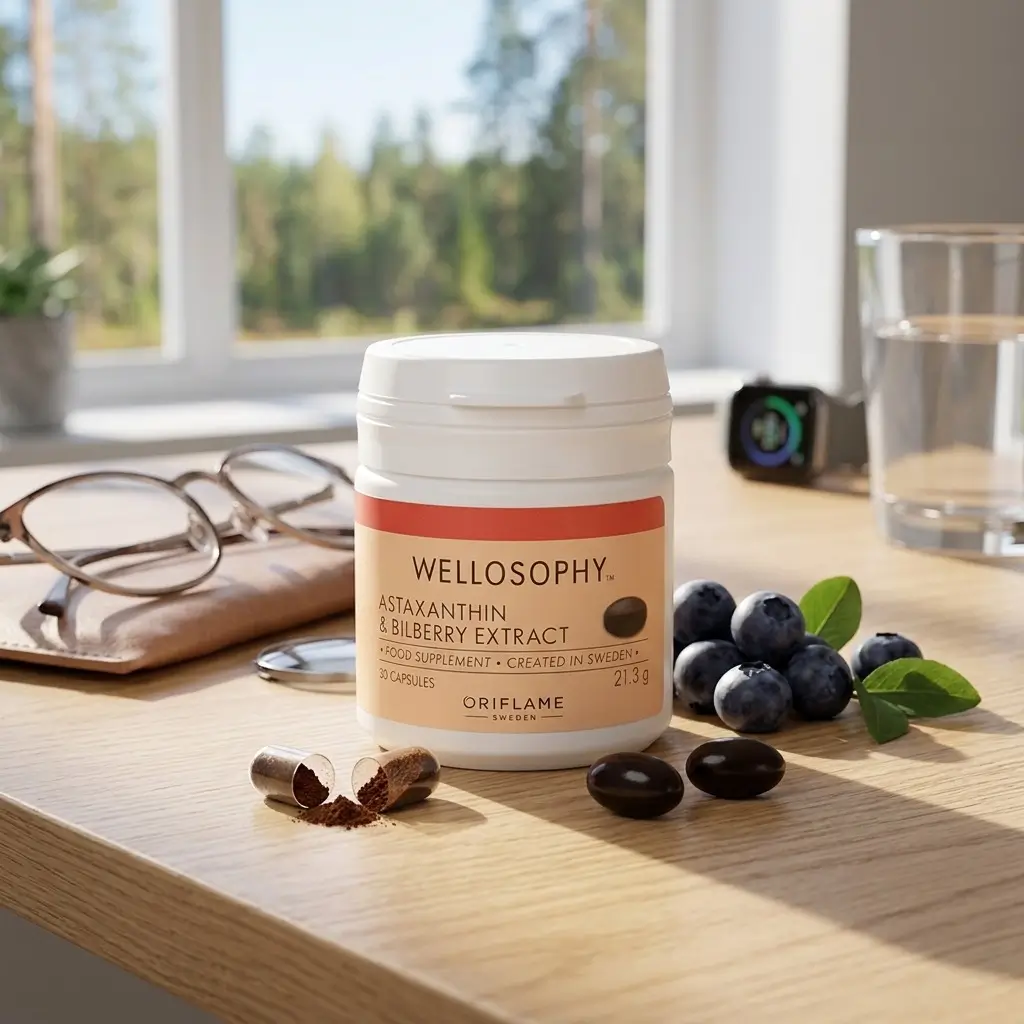
Wellosophy Astaxanthin & Bilberry Extract
The Wellosophy Astaxanthin & Bilberry Extract combines two complementary antioxidants in a single daily softgel:
- Natural astaxanthin provides the primary antioxidant protection, covering skin, eyes, cardiovascular tissue, and cellular health through the mechanisms described throughout this article.
- Bilberry extract contributes a different antioxidant family, anthocyanins, the deep-blue pigments found in bilberries, blueberries, and similar fruits. Bilberry has its own well-documented evidence base for eye health, particularly for reducing eye strain, supporting night vision, and protecting retinal microcirculation.
The pairing makes sense for several reasons. Both compounds support eye health through complementary mechanisms: astaxanthin via retinal oxidative protection, bilberry via vascular and photoreceptor support. Both contribute to skin antioxidant defence. And both address the oxidative stress drivers of premature ageing through different pathways, meaning their combined effect is more comprehensive than either alone. The product uses a softgel format with an oil base, addressing the absorption requirement that dry capsule astaxanthin formulations often miss.
Conclusion
Astaxanthin is one of those supplements where the quality of what you buy significantly affects what you get out of it. Natural vs synthetic, oil-based vs dry powder, clear dosage labelling vs vague “proprietary blend” language, these differences aren’t just marketing distinctions; they affect how much of the active compound actually reaches your cells. When you buy well, natural astaxanthin from Haematococcus pluvialis, in a properly formulated softgel, at a dose that matches what the research supports, you have a supplement with a genuine, well-evidenced range of benefits for skin, eyes, and long-term cellular health.