

What Makes the Best Bilberry Supplement?
- Standardised Anthocyanin Content
This is the single most important factor, and the one most often missing from low-quality bilberry products. Anthocyanins are the active compounds in bilberry that are responsible for its antioxidant, anti-inflammatory, and health-supporting properties. A standardised bilberry extract guarantees a specific, measurable amount of these compounds per serving. Quality bilberry supplements are typically standardised to 25–36% anthocyanins. This standardisation means that every batch of the supplement contains the same concentration of active compounds, the same level used in clinical research to produce documented benefits, as recognised by the European Medicines Agency.
Without standardisation, a product might list bilberry as an ingredient while containing an undefined, potentially very low amount of anthocyanins. The name on the label tells you nothing about efficacy if the active content isn’t specified.
- Natural Bilberry Extract
The extract should come from genuine bilberry, not a synthetic alternative, not a generic “mixed berry extract,” and not simply dried bilberry fruit powder. Natural bilberry extract retains the specific anthocyanin profile of the actual berry, which is what the clinical research has been conducted on. When possible, look for products that specify Vaccinium myrtillus as the source; this confirms you’re getting actual bilberry rather than a related berry used as a substitute for cost reasons.
- Transparent Ingredient List
A quality supplement lists every ingredient clearly, including excipients, the non-active ingredients used in capsule manufacture. Avoid products with vague “proprietary blends” that list bilberry without specifying how much, and steer clear of formulas with long lists of artificial colours, preservatives, or flavourings that serve no nutritional purpose. Clean formulations focus on the active ingredient and the minimum necessary excipients. Transparency here is a signal of a brand that takes quality seriously.
- Appropriate Dosage
Most clinical research on bilberry for eye health and antioxidant support has used doses in the range of 80–160mg daily of standardised extract at 25% anthocyanins. This translates to approximately 20–40mg of total anthocyanins per day. Products that offer significantly lower doses than this may not achieve the tissue accumulation levels that drive bilberry’s documented benefits. Products offering significantly higher doses without clear clinical justification may not provide proportionally greater benefit and could increase the likelihood of mild side effects.
- Third-Party Quality Testing
Independent laboratory testing verifies that the supplement contains what the label claims, in the stated amounts, without contamination. Look for products that reference third-party testing on their labels or websites, or that carry recognised quality certifications. A brand that subjects its products to independent testing is making a verifiable commitment to quality. One that doesn’t is asking you to take its faith claims.
- Reputable Manufacturer
Choose supplements from manufacturers who are transparent about their sourcing, extraction methods, and quality standards. Established brands with a track record in botanical supplements, who publish information about their manufacturing practices and quality controls, are more likely to deliver consistent, accurately labelled products than unverified suppliers.
Why Anthocyanins Matter
Anthocyanins are the compounds that make bilberry genuinely distinctive as a supplement, so it’s worth understanding why they’re the quality indicator everything else revolves around. Anthocyanins are a class of flavonoid polyphenols that give bilberry, blackcurrants, elderberries, and many other dark-coloured berries their deep pigmentation. They’re among the most potent plant-derived antioxidants studied in nutritional science.
In the body, they work through several mechanisms:
- Free radical neutralisation: Anthocyanins donate electrons to unstable free radicals, neutralising them before they damage cell membranes, proteins, and DNA.
- Enzyme activation: They upregulate the Nrf2 pathway, a molecular switch that increases production of the body’s own antioxidant enzymes, including superoxide dismutase and glutathione peroxidase.
- Anti-inflammatory signalling: Anthocyanins inhibit pro-inflammatory molecular pathways, reducing the chronic low-grade inflammation that drives accelerated ageing in skin, vascular tissue, and the eye.
- Capillary protection: They strengthen the walls of small blood vessels, a mechanism particularly relevant to the retinal microvasculature and the skin’s dermal capillary network.
Without a guaranteed, standardised amount of anthocyanins in the supplement you’re taking, you have no assurance that any of these mechanisms are being supported to a meaningful degree, according to research published in the National Library of Medicine.
Bilberry Supplement Benefits
When a bilberry supplement is properly formulated, standardised extract at an appropriate dose from a quality source, the clinical evidence supports several health applications:
- Eye Health and Digital Eye Strain
This is the area with the most consistent clinical evidence. Multiple randomised controlled trials have found that standardised bilberry extract significantly reduces digital eye strain symptoms, eye fatigue, dryness, blurred vision, and discomfort from screen use, over periods of 4–8 weeks. For anyone spending extended hours in front of screens, this is a practical and well-evidenced benefit. Beyond immediate eye comfort, bilberry anthocyanins accumulate in retinal tissue, providing ongoing antioxidant and capillary-protective support that may contribute to long-term retinal health and reduced age-related macular degeneration.
See our detailed guide on bilberry benefits for eyes for a full breakdown of the eye health evidence.
- Skin Health
Bilberry’s collagenase and elastase inhibition, meaning it reduces the enzymatic breakdown of collagen and elastin, directly supports skin firmness and elasticity. Its antioxidant protection of skin cells from UV and environmental oxidative damage, combined with microvascular improvements that support nutrient delivery to the dermis, makes it a relevant supplement for anyone focused on skin quality and healthy ageing. These skin benefits are internal and systemic, different from topical skincare, and complementary to it.
For more details, see our article on bilberry benefits for skin.
- Antioxidant Protection
The systemic antioxidant benefits of bilberry extend beyond the eyes and skin, protecting cell membranes, mitochondria, and DNA across multiple tissue types. This broad cellular protection is relevant for healthy ageing, energy metabolism, and the general maintenance of tissue function as oxidative damage accumulates over the years.
- Healthy Blood Circulation
Bilberry’s capillary-strengthening and anti-inflammatory effects on vascular endothelium support healthy microcirculation throughout the body. This is relevant to skin perfusion, retinal blood supply, and general cardiovascular wellness.
- Healthy Ageing and Daily Wellness
Used consistently as part of a broader wellness approach, bilberry provides ongoing antioxidant and anti-inflammatory support that contributes to slower cellular ageing across multiple systems. It’s not a dramatic intervention; it’s a consistent, daily protective measure that compounds over time, as noted by the National Center for Complementary and Integrative Health.
An important question when evaluating bilberry supplements is whether you want bilberry on its own or combined with complementary antioxidants.
Bilberry alone provides its specific anthocyanin profile and the mechanisms described above, well-suited for someone whose primary focus is eye health or antioxidant support from a single botanical ingredient.
Bilberry combined with astaxanthin provides a meaningfully broader antioxidant coverage, with the two compounds working through distinct, non-overlapping mechanisms:
- Astaxanthin crosses the blood-retinal barrier directly, providing antioxidant protection inside photoreceptor cells, specifically the intracellular dimension that bilberry’s capillary-focused mechanisms don’t reach.
- Bilberry provides retinal capillary support, vascular protection, and its diverse anthocyanin antioxidant activity, covering the circulatory and extracellular dimensions.
For eye health specifically, this combination offers comprehensive protection across the full anatomy of the retina, from the capillary network of bilberry to the photoreceptors themselves, astaxanthin. For skin, astaxanthin’s MMP-inhibiting and UV-protective effects combine with bilberry’s collagenase inhibition for a broader collagen-preservation strategy.
How to Choose the Best Bilberry Supplement
Before purchasing any bilberry supplement, run through these questions:
- Is the extract standardised? Does the label state a specific anthocyanin percentage? Look for 25–36%. If not specified, the active content is unknown.
- Is the source specified? Does it confirm Vaccinium myrtillus as the bilberry source? If not identified, it may be a substituted or mixed berry extract.
- Is the dosage appropriate? Does each serving provide 80–160mg of standardised extract? Below this range may be insufficient for documented benefits.
- Is the ingredient list clean? Are there unnecessary artificial additives, colours, or preservatives? A clean formula signals formulation integrity.
- Is third-party testing mentioned? Does the brand reference independent testing for purity and potency? Transparent brands make this information accessible.
- Is the manufacturer reputable? Is the brand established, transparent about manufacturing standards, and willing to share quality information? Opacity is a red flag.
- Is the format appropriate for absorption? For bilberry alone, the capsule format is standard. For combination formulas containing astaxanthin, an oil-based softgel significantly improves astaxanthin absorption, an important consideration for combination products.
Recommended Product
Wellosophy Astaxanthin & Bilberry Extract
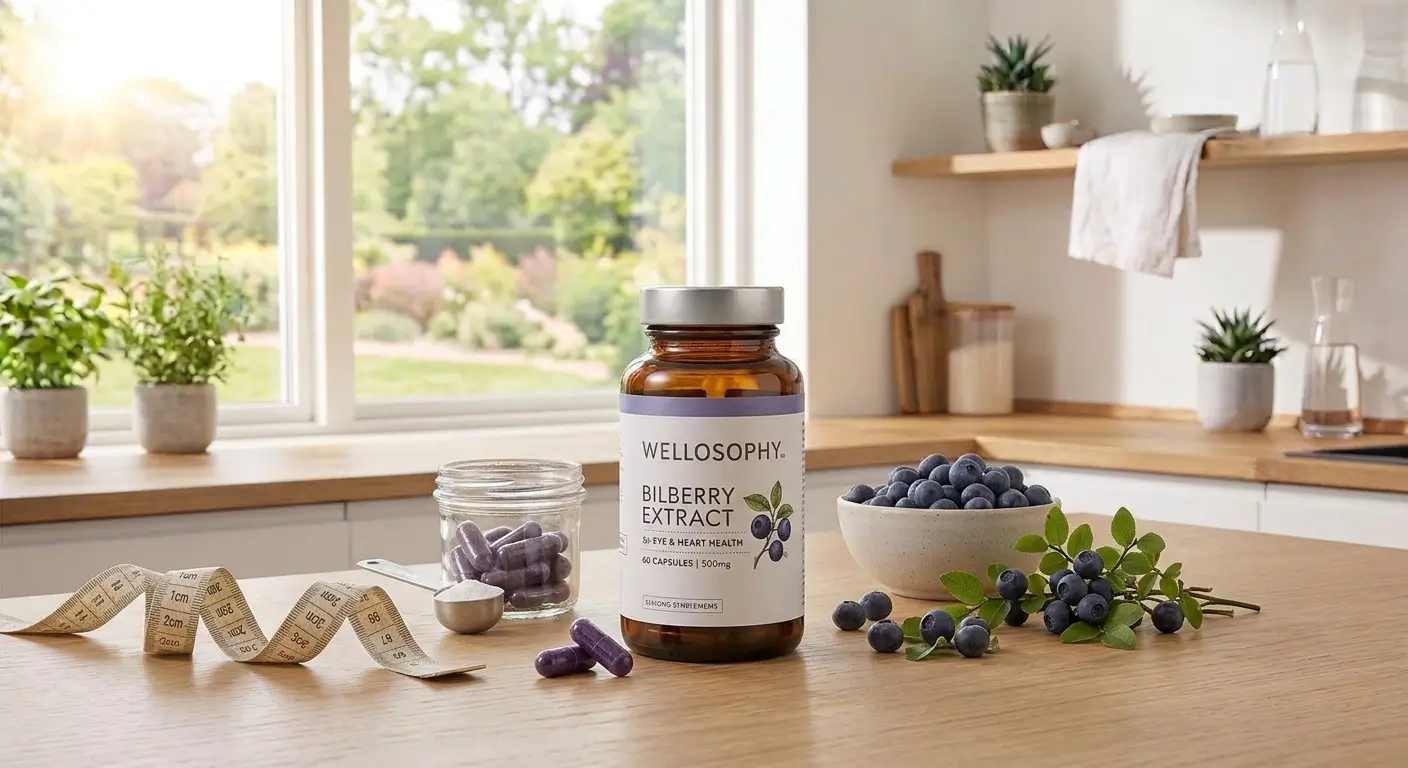
Based on the quality criteria above, the product we recommend is the Wellosophy Astaxanthin & Bilberry Extract. This formulation combines two well-researched antioxidants, standardised bilberry extract and natural astaxanthin from Haematococcus pluvialis microalgae, in a format designed for both effective daily use and genuine absorption.
Why it meets the quality criteria:
- Standardised bilberry extract with clearly specified active anthocyanin content
- Natural astaxanthin from Haematococcus pluvialis, the form used in human clinical research, not synthetic alternatives
- The oil-based softgel format is important for astaxanthin bioavailability, which depends on delivery in an oil matrix
- Clean formulation focused on the active ingredients without unnecessary additives
- Complementary combination: bilberry and astaxanthin address eye health, skin health, and antioxidant protection through distinct but synergistic mechanisms
We present this as one option that genuinely meets the selection criteria discussed in this article, not as the only possible choice, but as a formulation that delivers what a quality bilberry supplement should. It’s available in our wellness supplements store as part of our curated antioxidant range.
Conclusion
The bilberry supplement market offers a wide range of quality, from well-formulated, standardised extracts that genuinely deliver what clinical research supports, to products that trade on bilberry’s reputation while providing little meaningful active content. Whether you’re looking for support for eye health in a screen-heavy lifestyle, antioxidant protection for skin and healthy ageing, or a well-evidenced daily supplement for general wellness, a quality bilberry extract provides a meaningful foundation. Combined with astaxanthin, it offers broader coverage across specific tissues, eyes, and skin, where these antioxidants have the most targeted clinical evidence.