

The Ultimate Skincare Routine Guide: 5 Steps to Healthy Skin (Dermatologist-Approved)
Your skin is the largest organ in your body. It is your primary barrier against the external world, protecting you from pathogens, regulating temperature, synthesising vitamin D, and providing the sensory interface through which you experience everything around you. It’s also the organ most exposed to cumulative damage from UV radiation, pollution, lifestyle stress, and the passage of time.
Skin is organised into three primary layers, each with distinct functions:
The Epidermis: the outermost layer, responsible for the skin’s appearance, waterproofing, and the first line of barrier defence. The epidermis contains the keratinocytes that produce keratin (the structural protein of skin), melanocytes that produce pigment, and Langerhans cells that provide immune surveillance. The outermost sublayer, the stratum corneum, is a dense matrix of dead skin cells (corneocytes) embedded in lipid layers. This is the layer that skincare products interact with most directly.
The Dermis: the middle layer, containing collagen and elastin fibres that provide skin’s structure and elasticity, fibroblasts that produce these proteins, blood vessels, nerve endings, hair follicles, and sebaceous (oil) glands. This is where visible ageing, the loss of firmness, the deepening of wrinkles, and the reduction in facial volume originate.
The Hypodermis: the deepest layer, primarily adipose (fat) tissue that provides insulation, cushioning, and facial volume that contributes to a youthful appearance.
Every good skincare routine is built around protecting and supporting barriers. This single principle explains more about which products are genuinely useful and which are counterproductive than any ingredient list. Skin changes across a predictable trajectory, driven by a combination of intrinsic ageing (genetics, cellular senescence) and extrinsic ageing (UV radiation, pollution, lifestyle).
In your 20s: Collagen and elastin production are high. Cell turnover is rapid (approximately every 28 days). Skin recovers quickly from damage. The primary concern for most people is oil regulation and sun protection.
In your 30s: Collagen production begins a gradual decline of approximately 1% per year. Cell turnover slows. Fine lines appear, particularly around the eyes and mouth. Environmental damage from the 20s starts to become visible.
In your 40s and 50s: Cell turnover slows further to 45–60 days. Sebaceous glands become less active, reducing natural moisture retention. Hormonal changes, particularly declining oestrogen, accelerate collagen loss, reduce skin thickness, and compromise barrier function. The face loses volume from both collagen reduction and the natural redistribution of facial fat.
Post-menopause: The drop in oestrogen is the single most significant driver of rapid visible skin ageing in women. Research suggests women lose approximately 30% of collagen in the first five years post-menopause. Skin becomes thinner, drier, more reactive, and more susceptible to the visible effects of cumulative sun damage.
Understanding Your Skin Type
The Five Skin Types
- Normal Skin: Balanced sebum production, minimal sensitivity, small pores, even tone, and consistent texture. Genuinely normal skin is less common than the label suggests, and it tends to remain normal only with basic care and sun protection.
- Dry Skin: Characterised by tight, rough, or flaky texture, particularly after cleansing. Pores are small and barely visible. Skin may look dull or ashy, particularly on the cheeks and around the nose. Dry skin results from either insufficient sebum production or a compromised barrier that loses moisture rapidly. These require different approaches.
- Oily Skin: Enlarged pores, a persistent shiny or greasy appearance, particularly in the T-zone (forehead, nose, chin), and a tendency toward congestion, blackheads, and acne. Results from overactive sebaceous glands. Counterintuitively, oily skin often also needs hydration, dehydration can trigger increased sebum production as a compensatory mechanism.
- Combination Skin: Oily in the T-zone, normal to dry on the cheeks and around the eyes. The most common skin type in practice, requiring products and techniques that address both tendencies without exacerbating either.
- Sensitive Skin: Characterised by reactivity, flushing, stinging, itching, or redness in response to products, temperature changes, or environmental factors. Sensitive skin often has a compromised barrier. It requires the most careful product selection and is most likely to be worsened by overcomplicated routines.
Skin type is your skin’s baseline, determined by genetics and sebum production. Skin condition is its current state, influenced by season, climate, hormones, stress, sleep, diet, and product use.
You can have oily skin as your type while experiencing dehydration as a condition. You can have dry skin as your type but manage it well enough to have a normal skin condition. Understanding both allows you to respond to what your skin is actually doing rather than following a protocol built around a fixed label.
Understanding skincare is important, but knowing your own skin is what truly changes your results. If you’re unsure whether your skin is dry, oily, combination, sensitive, dehydrated, or reacting to the wrong products, our personalised skin test can help. Take the free Skin Test Quiz, it analyses your skin concerns, and skincare routine specifically to your skin type and needs.
Steps to Building a Skincare Routine
1. Cleanse. Remove the day’s accumulation of pollutants, bacteria, dead cells, SPF, and sebum. Without this step, nothing you apply afterward can penetrate or function effectively.
2. Moisturise. Maintain the barrier’s lipid content and provide the hydration that prevents moisture loss. Skipping moisturiser, even for oily skin, disrupts barrier function and can worsen the conditions you’re trying to manage.
3. Protect (SPF). UV radiation is responsible for an estimated 80% of visible skin ageing. No topical product counteracts the daily damage of unprotected sun exposure. SPF is not a summer product, it’s a daily non-negotiable.
Everything else in a skincare routine, toners, serums, exfoliants, eye creams, treatments, works within this foundation. Adding them without the foundation produces inconsistent results, according to the American Academy of Dermatology.
Step by Step for Morning Skincare Routine
- Step 1: Cleanser
Morning cleansing removes the sebum, dead cells, and any residue of overnight products that have accumulated on the skin surface during sleep. Choose your cleanser based on skin type:
- Dry or sensitive skin: Creamy, milky, or balm cleansers with low-pH formulas that don’t disrupt barrier lipids
- Normal or combination skin: Gel or foam cleansers with a balanced pH
- Oily skin: Foaming or gel cleansers that remove excess sebum without over-stripping
Always use lukewarm water. Hot water disrupts barrier lipids and exacerbates dryness and sensitivity.
- Step 2: Toner or Essence
An alcohol-free toner or hydrating essence serves two functions: it restores the skin’s pH balance after cleansing, and it provides a layer of lightweight hydration that improves the absorption of everything applied afterward. Look for ingredients like hyaluronic acid, panthenol, niacinamide, or glycerin. Avoid toners with high alcohol content, they strip the barrier and provide a false sense of cleanliness through the temporary tightening sensation.
- Step 3: Vitamin C Serum
Vitamin C is the most important morning active. As an antioxidant, it neutralises free radicals generated by UV exposure and pollution, damage that otherwise accumulates in skin cells, degrades collagen, and produces the uneven pigmentation and dullness of photoaged skin. Vitamin C also directly stimulates collagen synthesis and brightens skin tone by inhibiting melanin overproduction. Apply before moisturiser and SPF. Allow 30–60 seconds to absorb before the next step. Lascorbic acid is the most researched form; it’s unstable but effective when well-formulated. More stable derivatives (ascorbyl glucoside, sodium ascorbyl phosphate) work well for sensitive skin.
- Step 4: Eye Cream
The skin around the eyes is the thinnest on the face, typically 0.5mm compared to 2mm on the cheeks. It has fewer sebaceous glands, less subcutaneous fat, and moves constantly with facial expression. Fine lines appear here first, and dark circles and puffiness reflect both genetics and lifestyle. Apply eye cream before moisturiser, using the ring finger (which applies the least pressure) in gentle tapping motions. Look for caffeine (puffiness and circulation), peptides (fine lines), and niacinamide (dark circles).
- Step 5: Moisturiser
A moisturiser works through three mechanisms: humectants (hyaluronic acid, glycerin) draw water from the air and deeper skin layers to the surface; emollients (fatty acids, ceramides) fill gaps in the barrier and create a smoother surface; occlusives (shea butter, squalane) form a physical barrier that prevents moisture evaporation.
- Step 6: SPF 30+ Sunscreen
Apply last in the morning routine, over moisturiser, under makeup. Minimum SPF 30; SPF 50 for prolonged outdoor exposure, post-treatment skin, or anyone concerned with anti-ageing. Don’t neglect the neck and décolletage. These areas show ageing as visibly as the face, and are almost universally undertreated.
Step by Step for Evening Skincare Routine
- Step 1: Double Cleanse
If you’ve worn SPF or makeup, begin with an oil-based cleanser, cleansing balm, or micellar water to dissolve these products fully. Follow with your regular cleanser. Attempting to cleanse SPF with a single water-based wash leaves a residue that blocks subsequent products and clogs pores over time.
- Step 2: Exfoliation (2–3 times per week)
Exfoliation removes the accumulation of dead skin cells that slow cell turnover and create dullness, rough texture, and congestion. There are two primary approaches:
- Physical exfoliation: scrubs, cloths, or tools that manually buff the surface. The risk is over-exfoliation and micro-tears if the abrasive particles are too coarse. For the face, very fine physical exfoliants or gentle cleansing tools are preferable to traditional scrubs.
- Chemical exfoliation: AHAs (alpha hydroxy acids: glycolic, lactic, mandelic) work on the surface by dissolving the bonds between dead cells. BHAs (beta hydroxy acids: salicylic acid) are oil-soluble and penetrate pores, making them ideal for congested and oily skin. PHAs (polyhydroxy acids) are larger-molecule AHAs that work more gently, ideal for sensitive skin.
Do not exfoliate on the same night as retinol.
- Step 3: Serums
Night is when the skin’s repair and regeneration processes are most active, and when the most potent actives can be used, since retinol and many exfoliants increase photosensitivity.
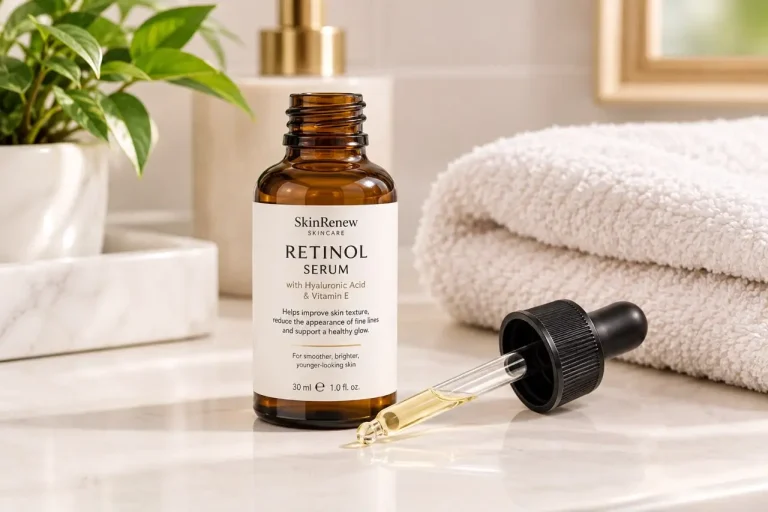
Retinol: The most evidence-backed anti-ageing ingredient available. Retinol (a vitamin A derivative) accelerates cell turnover, stimulates collagen synthesis, reduces fine lines, and fades hyperpigmentation. Start with a low concentration (0.025–0.1%) and increase gradually. Apply on alternate nights initially; build frequency slowly over 6–8 weeks as tolerance develops. Always follow with moisturiser.
Niacinamide: Can be layered over retinol or used on non-retinol nights. Strengthens the barrier, brightens tone, minimises pores, and reduces redness.
Peptides: Amino acid sequences that signal collagen production. Gentle enough to use every night and compatible with most other actives.
- Step 4: Eye Cream
A richer, more reparative eye cream is appropriate for evening use, one focused on peptides, antioxidants, and collagen support rather than caffeine, which is more useful for morning puffiness reduction.
- Step 5: Night Moisturiser or Night Cream
Night creams are typically richer and more occlusive than day moisturisers, designed to support the skin’s overnight repair processes rather than to create a protective layer against environmental stressors. Look for ceramides, peptides, niacinamide, and nourishing plant oils.
- Step 6: Facial Oil
Pressed over night cream, a few drops of a non-comedogenic facial oil (rosehip, squalane, marula, jojoba) provide an additional occlusive layer that seals everything in and prevents moisture evaporation overnight. Particularly beneficial for dry and mature skin in winter or dry climates.
For a detailed, step-by-step breakdown of active ingredient layering, see our dedicated guide to how to layer skincare products.
Anti-Ageing Skincare
The anti-ageing skincare market is saturated with claims. A useful filter: which ingredients have clinical evidence from peer-reviewed research, not just marketing studies?
- Retinoids (retinol, retinal, tretinoin): The most extensively studied anti-ageing category in existence. Evidence spans decades, across thousands of studies. Effects include accelerated cell turnover, stimulated collagen synthesis, reduced fine lines, improved skin texture, and faded pigmentation. Tretinoin (prescription retinoid) is the most potent; retinol (over-the-counter) is effective at the right concentrations.
- Vitamin C: Antioxidant protection and collagen synthesis support. Brightening and protective rather than directly reparative, most effective as a daily preventive measure.
- Peptides: Signal proteins to stimulate collagen and elastin production. Gentler than retinoids and compatible with sensitive skin. Effects are more modest but cumulative with consistent use.
- Niacinamide: Strengthens barrier function, reduces redness, improves skin texture, and fades pigmentation. One of the safest and most versatile anti-ageing ingredients, no photosensitivity and no sensitivity period.
- Hyaluronic acid: Hydration, plumping, and barrier support. Not a collagen producer, but its hydrating effects visibly reduce the appearance of fine lines by keeping skin cells plump.
- Sunscreen: Prevention is the most powerful form of anti-ageing. Consistent daily SPF is more effective at maintaining a youthful skin than any corrective treatment.
Skincare for Mature Skin
Mature skin, broadly defined as skin over 45, though changes often begin in the late 30s, requires a different formulation philosophy from the lightweight, fast-absorbing products suited to younger skin. Here’s what changes:
- Moisturisers: As sebum production declines and the barrier becomes more porous, richer creams with ceramides, squalane, and nourishing fatty acids provide the lipid content the skin no longer produces adequately itself.
- Retinoids: Once the skin has built tolerance, mature skin benefits from higher-potency retinol or prescription-strength retinoids for meaningful collagen stimulation.
- Serums: Peptide-rich serums specifically formulated to address skin density and firmness address the collagen loss that makes the most visible contribution to mature facial appearance.
- Exfoliation: Mature skin is thinner and more sensitive, over-exfoliation is a more significant risk. Lactic acid and mandelic acid (larger-molecule AHAs) are more appropriate than glycolic acid for mature and sensitive skin.
- SPF: The accumulated photodamage of decades becomes increasingly visible in mature skin, and ongoing sun exposure continues to degrade whatever collagen remains. SPF is arguably more important at 55 than it was at 25.
When multiple individual products need to work together for a mature skin concern as complex as collagen loss, barrier dysfunction, and declining hydration, a purpose-built system addresses these needs more reliably than individually assembled products from different brands, as the National Institute on Aging explains.
The Novage Restore Set is formulated specifically for mature skin, combining a serum, day cream with SPF, and restorative night cream designed to work synergistically for firmness, hydration, and skin density. The formulations are developed to complement each other, which is particularly important when working with the more reactive skin barrier of mature skin.
For a detailed, step-by-step guide to building a complete routine for older skin, see our dedicated resource: best skincare routine for mature skin over 50. And for women experiencing the specific skin changes associated with hormonal transition, our guide on how menopause affects your skin covers the science and practical response in full.
Body Care and Exfoliation
The skin below the neckline receives a fraction of the attention given to the face, and shows it. Dry knees, rough elbows, dull skin on the shins, crepey texture on the upper arms and décolletage, ashy patches on the heels. These are all addressable, not with complexity, but with consistency and the right approach. The most impactful single addition to a body care routine is exfoliation. The body’s skin has the same cell turnover mechanism as the face, but at a slower rate, and without the daily cleansing and toning that face routines provide. Dead skin cells accumulate on the surface, creating the dullness, roughness, and poor moisturiser absorption that characterise neglected body skin.
A body scrub removes this accumulation physically, stimulates circulation through the massage action, and leaves the skin surface smooth enough for body moisturiser to absorb at the depth where it actually works.
Choosing a Body Scrub or Exfoliator
Sugar-based scrubs are gentler than salt-based, the crystals dissolve during use, reducing the risk of over-exfoliation. Nourishing bases (honey, milk proteins, plant oils) provide hydration during the scrubbing process rather than simply removing cells. The Milk & Honey Gold Smoothing Sugar Scrub combines fine sugar crystals with honey and milk proteins, balancing effective exfoliation with genuine skin nourishment. For women with dry or sensitive body skin, or anyone who has found traditional scrubs too harsh, it’s one of the most well-rounded body exfoliators available.
For the full guide to body exfoliation, including scrub types, technique, and how to build a body care routine, see our dedicated resource: best body scrubs for smooth and glowing skin.
Nutrition and Skincare
No topical routine fully compensates for nutritional deficiencies that undermine skin health from within. Several key nutrients support the skin’s ability to build, repair, and protect itself:
- Omega 3 fatty acids (EPA and DHA) are incorporated into skin cell membranes, supporting barrier function, moisture retention, and the anti-inflammatory environment that keeps skin clear and resilient. For women with chronically dry or reactive skin, omega 3 deficiency is a frequently overlooked contributing factor that no moisturiser can address.
- Vitamin C: beyond its topical role, dietary vitamin C is a critical cofactor in collagen synthesis throughout the body.
- Zinc: essential for skin cell production, sebum regulation, and wound healing.
- Biotin, silica, and amino acids: support the structural proteins (collagen, keratin, elastin) that determine skin’s texture, firmness, and elasticity.
For women who want a holistic approach, connecting topical skincare with nutritional support for skin health, the Wellosophy Skincare Ritual Kit bridges these two dimensions, combining skincare products with the nutritional supplements that support their effectiveness from within.
Conclusion
Every skin type responds differently to products, ingredients, and routines. If you’re not sure where to start, take the free Skin Test Quiz to know your skin type, skincare routine and products best suited to your skin concerns and goals. The skincare foundation is always the same: cleanse, moisturise, protect. Everything built on top of that foundation, the actives, the treatments, the formulations, works in proportion to how well the foundation is maintained. For face care, start with what your skin type requires. Add activities gradually. Be consistent and patient. For mature skin navigating the specific challenges of collagen loss and hormonal change, a system like the Novage Restore Set provides a purpose-built starting point that addresses those challenges directly.
For body care, the most impactful change most people can make is adding consistent exfoliation, and the Milk & Honey Gold Smoothing Sugar Scrub is one of the gentlest, most nourishing ways to do it. And for those who want to connect the outer routine with nutritional support, the Wellosophy Skincare Ritual Kit brings both dimensions together, because the best skin is built from inside and outside simultaneously.
Continue reading our skincare articles:
- Best Skincare Routine for Mature Skin Over 50: the complete step-by-step guide for skin over 50
- How Menopause Affects Your Skin: the hormonal science and what to do about it
- Best Body Scrubs for Smooth and Glowing Skin: the full guide to body exfoliation
- How to Layer Skincare Products: the definitive guide to product application order
- Take the free Skin Test Quiz