

Does Retinol for Stretch Marks Really Work?
Retinol and its prescription-strength counterpart, tretinoin, are among the few ingredients with clinical evidence supporting improvement in early red stretch marks. They stimulate collagen production and increase cell turnover in the dermis. They do not remove stretch marks completely, and their effect on mature white marks is limited. They must be avoided during pregnancy and breastfeeding.
What Is Retinol?
Retinol is a form of vitamin A, specifically one of the retinoid family of compounds that includes everything from over-the-counter cosmetic ingredients to prescription medications. Understanding where retinol sits in this family helps clarify why prescription products tend to outperform OTC ones and why not all “retinoid” products are equivalent.
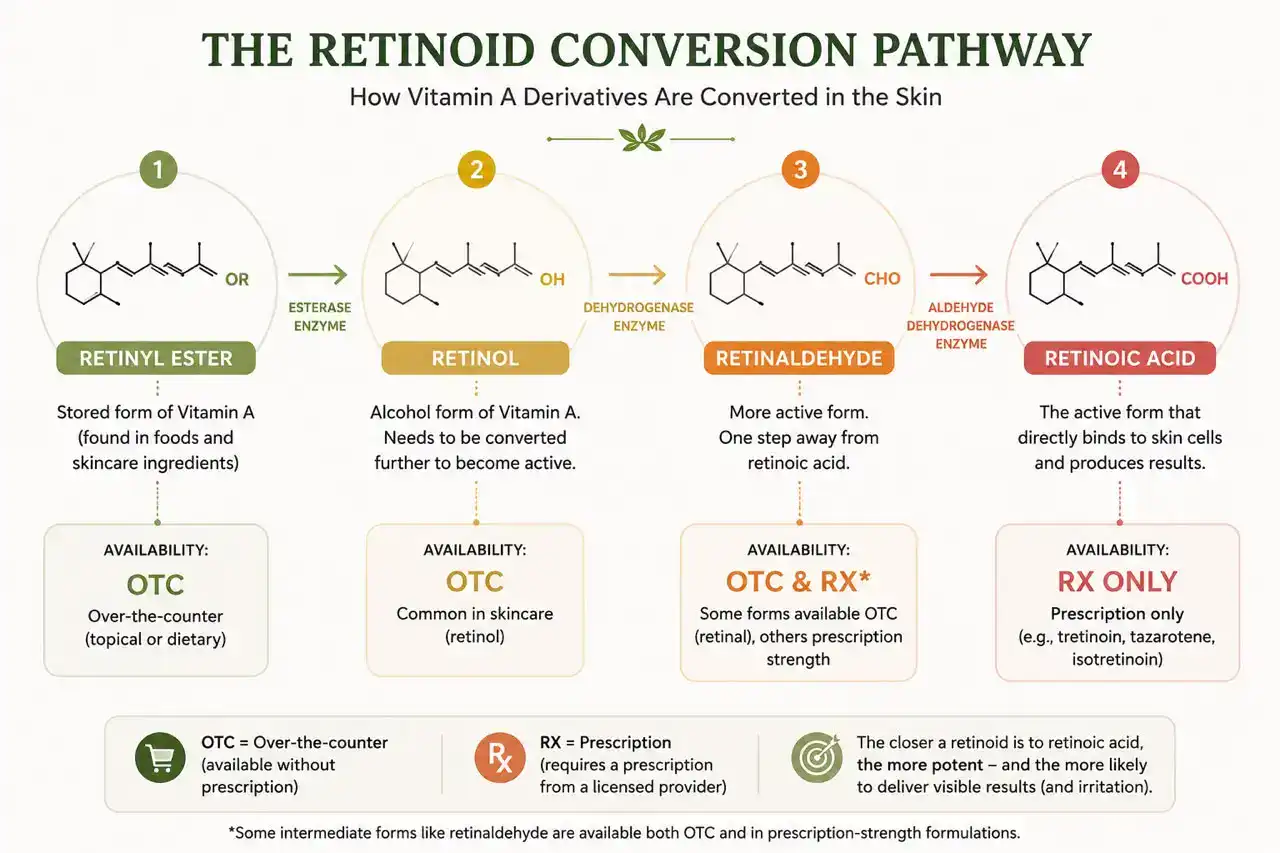
The retinoid family, in order of potency:
- Retinyl esters (retinyl palmitate, retinyl acetate), the mildest and most stable form, must be converted multiple times in the skin before becoming active
- Retinol, the primary form found in OTC skincare, must be converted once in the skin to retinaldehyde, then again to retinoic acid
- Retinaldehyde, one conversion step from retinoic acid; more potent than retinol but less irritating than prescription options
- Retinoic acid / Tretinoin, the biologically active form; no conversion needed; prescription-only; the standard against which all others are measured
How retinoids work at the cellular level:
Retinoic acid binds to nuclear receptors, retinoic acid receptors, or RARs, inside skin cells. This binding changes gene expression, activating genes that control cell turnover, collagen production, and the organisation of the dermis. Specifically relevant to stretch marks:
- Increased keratinocyte turnover: Faster renewal of epidermal cells improves surface texture and evenness
- Fibroblast stimulation: Fibroblasts are prompted to produce more collagen and modify the existing extracellular matrix
- Collagen remodelling: The disorganised collagen laid down during stretch mark healing is gradually replaced by more organised fibre structures
- Glycosaminoglycan production: Increased production of hyaluronic acid and other glycosaminoglycans improves skin plumpness and moisture retention in the dermis
Understanding Stretch Marks
Before examining what retinoids can do for stretch marks, a brief reminder of what stretch marks are structurally is in order, because this explains both retinol’s specific mechanism of benefit and its inherent limits. The epidermis, the outer skin layer, is where retinol primarily interacts, stimulating cell turnover and surface renewal. But stretch marks form in the dermis beneath it: the middle layer where collagen and elastin fibres provide skin with its tensile strength and elasticity.
When the skin stretches faster than fibroblasts can produce compensatory collagen and elastin, those fibres tear. The inflammatory healing response that follows is what makes new stretch marks red, with active blood vessels, fibroblasts at work, and the tissue in a state of repair. Over time, as healing completes, those vessels contract and the marks fade to silver or white, settling into stable scar-like tissue with reduced melanocyte activity and reorganised, but structurally abnormal collagen. Retinoids interact with this biology specifically through their ability to reach the dermis, deeper than most topical ingredients, and stimulate fibroblast activity and collagen production there. This is why they stand apart from emollients that stay primarily at the skin surface.
See our guide on Red Stretch Marks vs White Stretch Marks for the full biological breakdown of how stretch marks change over time.
How Retinol Works on Stretch Marks
- Collagen stimulation in the dermis: Retinoids prompt fibroblasts to increase collagen synthesis and to produce more organised collagen fibres, addressing the disorganised collagen architecture that stretch marks represent. This remodelling effect is incremental and takes months, but it has been demonstrated histologically, through skin biopsies, in multiple studies.
- Increased cell turnover in the epidermis: Faster epidermal renewal improves the surface texture of skin overlying stretch marks, reducing the visual appearance of textural irregularity.
- Improvement in skin elasticity markers: Studies on retinoids and skin ageing have shown improvements in skin elasticity measurements, relevant to stretch marks because increased elasticity means the skin’s surface above the mark presents differently to light, often appearing less prominent.
- Modulation of matrix metalloproteinases (MMPs): Retinoids influence the enzymes that break down and remodel the collagen matrix, helping to shift the balance from collagen breakdown toward productive remodelling.
What Does Scientific Research Say?
The most rigorous evidence for stretch mark improvement comes from studies on tretinoin, the prescription-strength retinoid. Several randomised controlled trials have evaluated its effect on early stretch marks. A landmark study published in the Archives of Dermatology applied 0.1% tretinoin cream to striae rubrae, red stretch marks, and found statistically significant reductions in stretch mark length and width after 24 weeks of daily use, confirmed by clinical assessment and histological analysis. Skin biopsies showed measurable increases in collagen deposition and epidermal thickness in treated areas compared to untreated controls.
Tretinoin consistently produces measurable improvement in red stretch marks when applied daily over 3–6 months. The improvements are real, documentable, and statistically significant, which places tretinoin above every other ingredient in this category.
OTC retinol has considerably less dedicated clinical data for stretch marks than prescription tretinoin. However, given that retinol acts through the same mechanism via conversion to retinoic acid in the skin, the dermatological consensus is that retinol can produce similar improvements over a longer timeline and at a lower magnitude of effect. Retinol is less potent than tretinoin because conversion losses reduce the amount of active retinoic acid that ultimately reaches skin cell receptors. A consistent 0.5% retinol product used nightly will produce improvement, but more slowly and less dramatically than 0.025–0.1% tretinoin.
The American Academy of Dermatology and the Mayo Clinic both include tretinoin among the treatments with the strongest evidence for improving stretch mark appearance, with the caveat that it works best on newer red marks and is not suitable during pregnancy or breastfeeding. Retinoids of any form are not positioned as “stretch mark removers” by dermatologists; they are positioned as meaningful improvement tools for early stretch marks, requiring consistent use and realistic expectations about timelines and degree of improvement.
Retinol for Red Stretch Marks
Red stretch marks are where retinol and tretinoin produce their best results, and this is not incidental. The biology of this stage is precisely what makes the retinoid mechanism most effective. At the red or purple stage, the dermis tissue is still active. Fibroblasts are working. Blood vessels are present. The collagen remodelling that retinoids stimulate can amplify and redirect an ongoing biological process rather than having to restart a dormant one.
What consistent retinol use achieves for red marks:
- Measurable reduction in the length and width of individual marks, demonstrated in tretinoin trials
- Improvement in surface texture as epidermal cell turnover accelerates
- Some colour improvement, as the inflammatory response is modulated
- Improved collagen organisation in the dermal repair tissue
See our guide on Red Stretch Marks vs White Stretch Marks for why the treatment window at this stage is so significant.
Retinol for White Stretch Marks
By the time stretch marks are fully white and mature, the tissue has settled into a stable state. Fibroblast activity has significantly reduced. The collagen architecture is fixed. Blood vessels have contracted. The inflammatory signals that retinoids work most effectively with are no longer present. Retinoids can still produce some improvement in white marks; the collagen stimulation mechanism does not switch off entirely; it just has much less active tissue to work with. Some studies have shown texture improvement in white marks with long-term retinoid use, and practitioners sometimes include retinoids in combination treatment protocols for mature marks. But the degree of improvement is substantially less than for red marks, requires longer treatment, and typically benefits from clinical procedures alongside or instead of retinoids.
For mature white stretch marks, fractional CO₂ laser and radiofrequency microneedling are the treatments most likely to produce meaningful visible improvement. A dermatologist consultation is the most valuable next step for anyone in this situation.
Retinol vs Tretinoin: A Direct Comparison
| Feature | Retinol (OTC) | Tretinoin (Prescription) |
|---|---|---|
| Prescription required | No | Yes |
| Conversion needed to become active | Two steps | None (already retinoic acid) |
| Typical concentration range | 0.025%–1% | 0.025%–0.1% |
| Potency | Moderate | Strong |
| Evidence for stretch marks | Moderate (inferred from mechanism) | Strong (multiple RCTs) |
| Speed of results | Slower (6–12 months typically) | Faster (3–6 months) |
| Side effects | Milder, manageable for most | More pronounced initially |
| Cost | Low–Moderate | Moderate (with consultation) |
| Suitable for sensitive skin | Generally, yes, starting at low concentrations | Requires more careful introduction |
| Safe during pregnancy | No | No |
| Safe during breastfeeding | No | No |
| Best used | Nightly | Nightly |
| Main advantage | Accessible without prescription | Stronger, faster results |
How to Use Retinol Safely for Stretch Marks
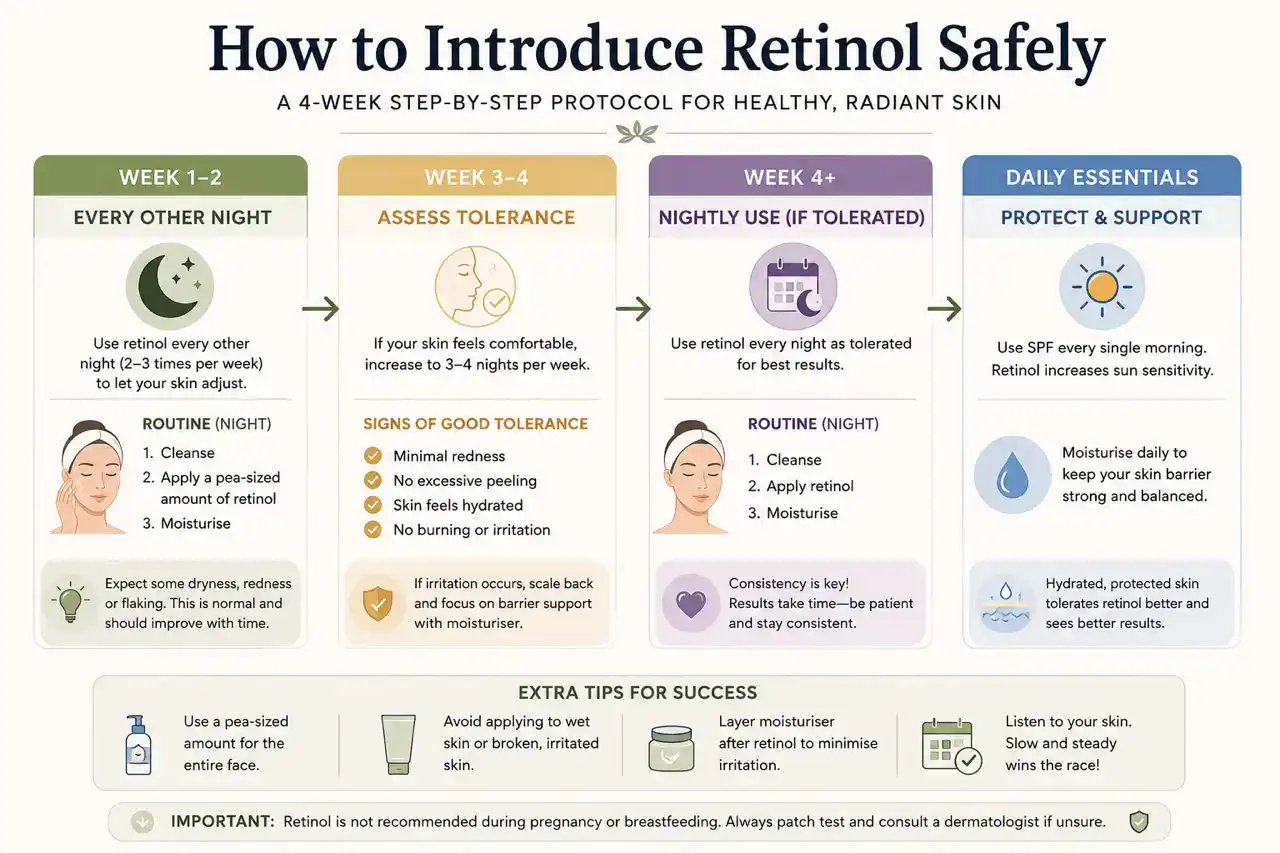
Getting retinol right matters as much as choosing it. Misused, it causes irritation that leads people to abandon treatment before results appear. Used correctly, it is one of the most accessible and effective tools available. Retinol is photosensitive; it degrades in UV light, and it also increases the skin’s sensitivity to sun damage. Consistent nighttime application avoids both problems. Always apply SPF to any retinol-treated skin during the day.
The most common mistake with retinol is beginning at too high a concentration or using it too frequently. For the body, which is more resilient than the face, begin with every-other-night application for the first 2–4 weeks. Assess skin tolerance, then progress to nightly use.
Side Effects to Understand and Manage
- Dryness: The increased epidermal cell turnover that retinol produces can initially strip the skin’s surface, resulting in temporary dryness and tightness. A good moisturiser applied before or after retinol significantly reduces this.
- Peeling and flaking: Common in the first 2–4 weeks of use. The skin’s turnover rate is adjusting to the increased retinol signal. This typically resolves as the skin acclimates.
- Redness and irritation: Particularly common with higher concentrations or in people with sensitive skin. Starting at a low concentration of 0.025–0.1% for body use and building gradually is the standard approach.
- Photosensitivity: Even when applied only at night, retinol increases the skin’s UV sensitivity during the day. Consistent SPF use on treated areas is not optional; it is a fundamental part of safe retinol use.
- Purging: Some people experience a brief increase in skin congestion when starting retinol, as accelerated cell turnover clears congested pores. This typically resolves within a few weeks and is distinct from a persistent reaction that might indicate intolerance.
Pregnancy and Breastfeeding: A Non-Negotiable Caution
All retinoids, including retinol, tretinoin, retinaldehyde, retinyl palmitate, and any other vitamin A derivative, must be avoided during pregnancy and breastfeeding. Vitamin A in elevated systemic concentrations is teratogenic; it is associated with serious foetal developmental abnormalities. The systemic absorption of topically applied retinoids is lower than oral intake, but it is not zero. Dermatology guidelines from multiple professional bodies consistently advise avoiding all topical retinoids during pregnancy and breastfeeding without exception.
For stretch mark care during pregnancy or breastfeeding, the evidence-based options are: hyaluronic acid, Centella asiatica, peptides, shea butter, sweet almond oil, and avocado oil, all of which support skin hydration and conditioning without the contraindications of retinoids.
See our comprehensive guide on Stretch Marks During Pregnancy for pregnancy-safe skincare options.
Choosing a Retinol Product for Stretch Marks
Concentration effective ranges are:
- Starting point: 0.025%–0.1%, suitable for sensitive skin or first-time users
- Established use: 0.3%–0.5%, the range where most meaningful improvement occurs
- Advanced use: 0.5%–1%, maximum OTC range; more effective but higher irritation potential
The best retinol products for stretch mark care pair the active ingredient with:
- Hyaluronic acid, to counteract the potential dryness
- Niacinamide, an anti-inflammatory, reduces retinol-induced irritation
- Centella asiatica supports collagen production and soothes
- Peptides, complementary collagen signalling
- Vitamin E, an antioxidant, stabilises the retinol and supports the skin barrier
Supporting Your Skin While Using Retinol
Balancing the retinol application with a genuinely nourishing moisturiser makes the routine more sustainable and keeps the skin in better overall condition throughout treatment. In the morning, when retinol is not applied, applying a nourishing body oil before or after your usual moisturiser supports the skin barrier and compensates for any dryness the overnight retinol may have produced.
The Love Nature Nourishing Body, Face & Hair Oil with Organic Avocado Oil is a morning complement to a retinol evening routine. Its oleic acid content provides sustained daily moisturisation, its vitamin E supports the skin’s antioxidant protection, and its phytosterol content contributes mild anti-inflammatory activity. Applied in the morning to slightly damp skin with massage, it keeps the skin soft and hydrated through the day, helping to offset the dryness that retinol can cause overnight. Apply retinol in the evening and avocado oil in the morning, not simultaneously. Applying oil immediately before retinol reduces its penetration; applying oil immediately after retinol may similarly dilute the contact time. Keeping them in separate parts of the routine allows each to work without interference.
Retinol vs Other Stretch Mark Ingredients
| Ingredient | Evidence for Stretch Marks | Collagen-Stimulating Mechanism | Pregnancy Safe | Speed of Results |
|---|---|---|---|---|
| Retinol (OTC) | Moderate–Strong | Yes (indirect via conversion) | No | Slow (6–12 months) |
| Tretinoin (Rx) | Strong | Yes (direct, no conversion needed) | No | Moderate (3–6 months) |
| Centella asiatica | Moderate | Yes (collagen synthesis support) | Yes | Moderate |
| Hyaluronic acid | Moderate–Strong | Indirect (hydration + some collagen support) | Yes | Quick (hydration) |
| Shea butter | Limited | No | Yes | N/A (moisturising only) |
| Almond oil | Limited–Moderate | No | Yes | N/A (moisturising) |
| Avocado oil | Limited | No | Yes | N/A (moisturising) |
| Coconut oil | Limited | No | Yes | N/A (moisturising) |
| Aloe vera | Limited | No | Yes | N/A (soothing/hydration) |
| Cocoa butter | Very limited | No | Yes | N/A (moisturising) |
See our ingredient guides on Shea Butter for Stretch Marks, Avocado Oil for Stretch Marks, Almond Oil for Stretch Marks, Coconut Oil for Stretch Marks, and Aloe Vera for Stretch Marks.
When Professional Treatments May Be Better
Consider professional treatment when:
- Stretch marks are already white; retinoids have a limited effect on mature marks; laser and microneedling produce far more significant improvement
- You want faster, more pronounced results than months of topical treatment can deliver
- Topical retinol has been used consistently for 6+ months without satisfactory progress
- The stretch marks are extensive or deeply textured
- Significant emotional distress is driving the desire for treatment; a dermatologist can recommend the most appropriate, realistic approach
The most effective clinical options are:
- Microneedling: Creates controlled dermal micro-injury, stimulating fibroblast activity and collagen remodelling. Works on both red and white marks.
- Radiofrequency microneedling: Combines mechanical stimulation with thermal energy for deeper collagen remodelling. Increasingly preferred over standard microneedling for combined colour and texture improvement.
- Fractional CO₂ laser: The most powerful single option for white stretch marks; it produces significant texture and colour improvement over a series of sessions. Requires more recovery than microneedling.
- Pulsed dye laser: Most effective for red marks; targets the active blood vessels, reducing redness and stimulating some remodelling.
- Combination therapy: The most effective clinical approaches combine modalities, often retinoids in the periods between clinical sessions, to maintain and amplify the remodelling effect between appointments.
See our complete guide on Stretch Mark Treatment Options for a full breakdown of clinical procedures and their evidence.

Conclusion
Retinol occupies a unique position in stretch mark care: it is one of the very few ingredients whose mechanism of action directly addresses the dermal changes stretch marks represent, and one of even fewer with actual clinical trials to support its use. It does not work for everyone, it does not work fast, and it barely works for mature white marks. But for someone with red stretch marks who is willing to commit to a consistent nightly routine for at least six months, and who is not pregnant or breastfeeding, retinol is a more evidence-informed choice than almost anything else available without a prescription.
A 1% retinol applied to white stretch marks three times a week for two months will produce approximately nothing. The same product applied nightly to red stretch marks for six months may produce results that are visible and lasting, not a cure, but a meaningful improvement that tracks with what the clinical evidence would predict.
How to Prevent Stretch Marks | Red Stretch Marks vs White Stretch Marks | Stretch Mark Treatment Options → Stretch Marks During Pregnancy: safe alternatives during pregnancy and breastfeeding