

How to Layer Skincare Products: The Ultimate Step-by-Step Order
Skincare works through chemistry and physics. Products are designed to deliver specific ingredients to specific layers of skin, and this delivery depends on the skin surface being in the right condition to receive them when they’re applied. The outermost layer of skin, the stratum corneum, is the primary interface through which all products must either penetrate or work at the surface level. It functions as a selective barrier: it lets some things through and keeps others out, based on the size of the molecules involved, the chemistry of the product, and the condition of the barrier itself.
Smaller molecules penetrate more easily. Water-based formulas absorb before oil-based ones. Products applied to clean, hydrated skin absorb better than those applied to dry or congested surfaces. A thick moisturiser applied before a lightweight serum creates a physical film that the serum cannot easily penetrate. The occlusive layer sits between the serum’s active ingredients and the skin surface that needs them. Applying a serum to freshly cleansed, toned skin, with the surface open and receptive, delivers those actives at their maximum effectiveness. Applying oil before a water-based product effectively prevents the water-based product from absorbing at all, since oil and water don’t mix, and the oil film repels water-based formulas.
The foundational principle of correct skincare layering is thinnest formula to thickest. Lightest textures first, heaviest last. Water-based before oil-based. Treatments before moisturisers. Moisturisers before occlusive seals. Once you understand this principle, the order of every product in your routine becomes perfect.
Before getting into the specifics order, this helps to understand what each product category is, and why it exists, so the sequence makes sense rather than just being a list to memorise.
- Cleanser
Your cleanser’s job is to remove everything that has accumulated on the skin surface since you last cleaned it: excess sebum, dead skin cells, environmental pollutants, bacteria, makeup, and SPF residue. It creates a clean foundation from which everything that follows can penetrate properly. Choose a formula suited to your skin type and use lukewarm water, not hot.
- Toner
Toners have evolved considerably from the alcohol-heavy predecessors that existed primarily to strip residual cleanser and “close pores”. Modern toners are either hydrating preparations that prepare the skin to absorb subsequent products, or active-containing treatments delivering exfoliating acids (AHAs, BHAs) or targeted actives in a lightweight format. It is applied after cleansing. A hydrating toner increases the skin’s moisture content, creating a more receptive surface for serums. An exfoliating toner (used in the evening, not combined with other exfoliants or retinol) performs chemical exfoliation at the skin surface before treatment steps.
- Essence
An essence sits between toner and serum on the texture spectrum and in the product application order. Originally popularised by Korean skincare, essences are lightweight, watery formulas with a high concentration of active ingredients, ferments, peptides, or hydrating actives that absorb quickly and prepare the skin for the serums that follow. Not everyone needs an essence; if your routine already has a toner and serums, then essence is an optional but often beneficial extra step for women focused on maximising hydration and skin renewal.
- Serum
Serums are the workhorses of any skincare routine, the products where most active ingredient concentration and treatment intent live. They are thinner than moisturisers, formulated to carry a high payload of actives to the skin, and designed to be applied before occlusive or moisturising layers that would otherwise block their penetration. A vitamin C serum applied in the morning delivers antioxidant protection and collagen stimulation. A retinol serum applied at night drives cellular renewal. A niacinamide serum strengthens barrier function and brightens tone. A hyaluronic acid serum attracts water to the skin’s surface layers. The serum step is where most of the targeted treatment in your routine happens.
- Moisturiser
The moisturiser’s job is to hydrate the skin surface and to seal in the products applied before it. It works through three mechanisms: humectants that draw water to the skin surface, emollients that fill gaps in the barrier and create a smoother texture, and occlusives that form a layer that slows moisture evaporation. This is applied after serums, a moisturiser that delivers its own hydrating benefits and locks the actives from preceding steps against the skin, improving their contact time and effectiveness.
- Facial Oil
Oils sit at the top of the texture hierarchy; they are the most occlusive category of skincare product, forming a lipid layer over everything beneath them. If applied over moisturiser in the evening, they provide an additional seal that prevents moisture loss overnight. If applied under moisturiser, they cannot function as the occlusive seal they’re designed to be, and the moisturiser sitting on top of them doesn’t absorb properly. Facial oils are not appropriate for all skin types; very oily or acne-prone skin may not need the additional lipid layer, and certain oils are comedogenic. For dry and mature skin, they’re among the most effective tools for overnight barrier repair.
- SPF (Sunscreen)
Sunscreen is not an optional finishing step; it is the single most powerful anti-ageing tool in any skincare routine. UV radiation is responsible for an estimated 80% of visible skin ageing: the fine lines, the pigmentation, the degradation of collagen, and the loss of elasticity. No serum, no treatment, no moisturiser undoes the daily damage of unprotected sun exposure. It is applied last in the morning routine, over moisturiser, under makeup, and reapplied throughout the day for meaningful ongoing protection. Minimum SPF 30; SPF 50 for anyone serious about anti-ageing or with a history of significant sun exposure.
Steps To A Morning Skincare Routine
Step 1: Cleanser
Morning cleansing removes the overnight accumulation of sebum, dead cells, and anything your pillowcase deposited on your skin during the night. For most people, a gentle cleanser rather than a double cleanse is sufficient in the morning, and overnight, you haven’t applied SPF or makeup that requires the two-step removal process. Use lukewarm water and gentle pressure. Pat dry rather than rubbing.
Step 2: Toner
Apply your hydrating toner while your skin is still slightly damp from cleansing. The combination of the toner’s humectants and the residual moisture creates a more hydrated surface for serums. Apply by pressing gently into the skin with clean hands or a cotton pad, working from the centre of the face outward. Skip toner containing exfoliating acids in the morning if you’re also using a vitamin C serum; unnecessary acid loading in the morning routine can destabilise vitamin C and irritate sensitive skin.
Step 3: Vitamin C Serum
Vitamin C is the most important morning active. As an antioxidant, it neutralises the free radicals generated by UV exposure and pollution damage that would otherwise accumulate in skin cells, degrade collagen, and produce the uneven pigmentation and dullness of photoaged skin. It also directly stimulates collagen synthesis and brightens existing pigmentation. Apply to the full face and neck on freshly toned skin. Allow 30–60 seconds to absorb before the next step. Vitamin C works best when it’s had a moment to begin absorbing rather than being immediately diluted by the next layer.
L-ascorbic acid (pure vitamin C) is the most researched form and the most potent, but it’s also the most unstable and can irritate sensitive skin. More stable derivatives, ascorbyl glucoside, sodium ascorbyl phosphate, and tetrahexyldecyl ascorbate, work well for those who find pure vitamin C problematic.
Step 4: Eye Cream
The skin around the eyes is the thinnest on the face, approximately 0.5mm compared to 2mm elsewhere, and it behaves differently from the rest of the face. It has fewer sebaceous glands (meaning less natural lubrication), constant mechanical stress from blinking and expression, and it shows the first signs of ageing and dehydration. Apply eye cream before moisturiser so it makes direct contact with the delicate periorbital skin. Use your ring finger, which naturally applies the least pressure, and tap gently rather than rubbing. Work from the inner corner outward, along the orbital bone.
Step 5: Moisturiser
Apply your morning moisturiser over your serum and eye cream. Match the formula to your skin type: lighter gels and fluid creams for oily and combination skin, richer creams for dry and mature skin. The moisturiser seals everything applied before it, providing its own hydrating benefits while extending the contact time of your actives. Extend application to your neck and décolletage; these areas are just as subject to ageing and sun exposure as the face, and they receive a fraction of the attention.
Step 6: Sunscreen
Apply your SPF last. over all other products, and apply it generously. A common mistake is applying too little; the SPF rating on a product is calibrated for a specific application weight (2mg per cm²), and most people apply approximately a quarter of that. For the face alone, a full teaspoon (5ml) of product is appropriate.
Steps To An Evening Skincare Routine
Step 1: Double Cleanse
In the evening, is when you remove everything your skin has been protected by and exposed to throughout the day. If you’ve worn SPF (which you should have) and/or makeup, begin with an oil-based cleanser, micellar water, or cleansing balm to dissolve these formulations. Follow with your regular water-based cleanser for a thorough second cleanse. Attempting to cleanse off sunscreen with a single water-based wash leaves a residue that blocks subsequent products and gradually congests pores. The double cleanse is not excessive; it’s appropriate for any skin that has worn SPF during the day.
Step 2: Exfoliation (2–3 Times Per Week)
Chemical exfoliants, alpha hydroxy acids (glycolic, lactic, mandelic), and beta hydroxy acids (salicylic acid), dissolve the bonds between dead skin cells at the surface, revealing the fresher, brighter skin beneath without the micro-tears that harsh physical scrubs can create. Apply after cleansing, before serums, on the nights you exfoliate. Do not combine chemical exfoliants with retinol on the same night; both increase skin cell turnover, and the combination risks significant irritation. Alternate: exfoliant nights, then retinol nights.
AHA acids (glycolic, lactic, mandelic) work on the skin surface. Glycolic is the most potent and smallest molecule, most effective, but potentially most irritating. Lactic acid is gentler and also hydrating. Mandelic acid (from almonds) has the largest molecule size of the three, is the gentlest, well-suited to sensitive skin.
BHA (salicylic acid) is oil-soluble; it penetrates pores, making it ideal for congested, oily, and acne-prone skin. It also has anti-inflammatory properties.
Step 3: Treatment Serum
On non-exfoliant evenings, your treatment serum is the step where the most active work of the routine happens. Niacinamide, peptide serums, growth factor formulations, brightening serums. Apply these after cleansing and any acid treatment (if combining a low-concentration toning acid with a separate serum, wait 5 minutes between the two).
Step 4: Retinol
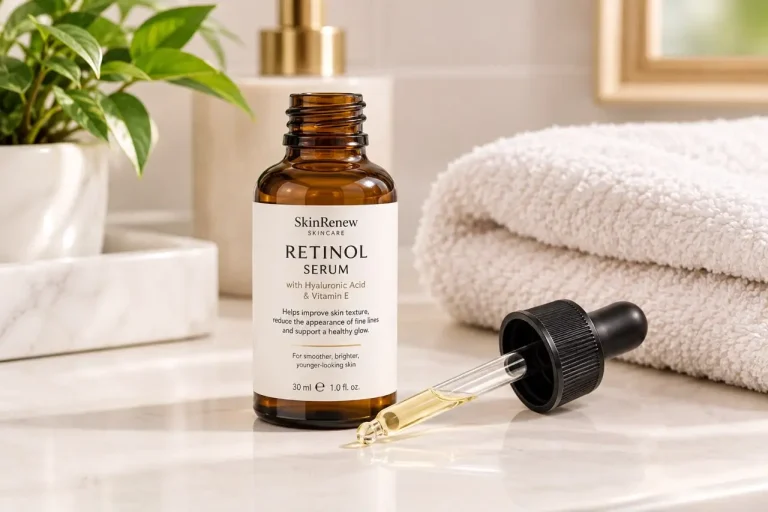
Retinol is the most anti-ageing ingredient available without a prescription. It accelerates skin cell turnover, stimulates collagen synthesis, reduces the appearance of fine lines, fades hyperpigmentation, and improves skin texture. It deserves its own application step, applied after the treatment serum, before eye cream. Retinol introduces a sensitivity and dryness period known as the “retinol purge” or adjustment phase, starting gently (0.025–0.1% concentration, two nights per week) and gradually building. After 6–8 weeks at low concentration, you can increase frequency and eventually concentration as tolerance builds, as the American Academy of Dermatology recommends.
A pea-sized amount for the entire face is sufficient. Apply 20–30 minutes after cleansing on dry skin; applying to damp skin increases irritation potential. Always follow with moisturiser.
Step 5: Eye Cream
The eye cream can be richer than the morning version, focused on overnight repair rather than the daytime puffiness and circulation concerns that caffeine addresses. Look for peptides, ceramides, hyaluronic acid, and vitamin E in your eye cream. Apply before your night cream so it can make direct contact with the periorbital skin rather than being applied over a rich cream.
Step 6: Night Cream
A night cream is richer and more nourishing than a day moisturiser, designed to support the skin’s natural overnight regeneration processes. The skin’s repair activity peaks between 10 pm and 2 am, and a night cream formulated with ceramides, peptides, niacinamide, and nourishing plant lipids provides the supportive environment for this repair work. For mature skin, a rich night cream is one of the most impactful steps in the routine. The combination of increased skin thickness, deeper hydration, and active repair support produces the difference between skin that shows ageing rapidly and skin that ages slowly.
Step 7: Facial Oil
A few drops of a non-comedogenic facial oil pressed over your night cream provides an additional occlusive seal that prevents moisture loss overnight. Rosehip oil, squalane, marula oil, and jojoba oil are well-suited to most skin types. Avoid highly comedogenic oils (coconut oil, cocoa butter) if you are prone to congestion. This step is particularly beneficial for dry, mature, or very dehydrated skin, and during winter or in dry climates where TEWL (transepidermal water loss) is greater.
How long does it take to layer Skincare?
For most products, 30–60 seconds of absorption time is enough. This isn’t about the product penetrating deeply in 30 seconds; it’s about allowing it to bind to the skin’s surface before being diluted or displaced by the next layer.
For vitamin C (L-ascorbic acid): Allow 60–90 seconds. L-ascorbic acid works best at a low pH, and giving it a moment to begin acting before applying the next product (which may have a different pH) improves efficacy.
For retinol: The conventional advice to “wait 20–30 minutes after cleansing before applying retinol” is meant to ensure the skin is fully dry. Retinol on damp skin absorbs more intensely and is more likely to irritate. Once your skin is dry after cleansing, retinol can be applied without an extended wait.
For exfoliating acids: Allow 5 minutes after applying an exfoliating toner or acid treatment before proceeding to the next step. This gives the acid time to work at its optimal pH before being disrupted by a product with a different pH.
Skincare Ingredients Mostly Needed:
- Vitamin C + Niacinamide
This combination has generated more debate in the skincare community than almost any other. Vitamin C and niacinamide can theoretically react to form nicotinic acid, causing temporary flushing and potentially reducing the efficacy of both. This reaction requires high temperatures and prolonged reaction time, conditions not present in normal skincare applications. If you prefer to keep them separate as a precaution, apply vitamin C in the morning and niacinamide in the evening (or in a different morning step, after allowing vitamin C to absorb).
- Retinol + AHA/BHA Exfoliants
This is the combination to genuinely avoid applying on the same evening. Both retinol and exfoliating acids increase skin cell turnover; the combination doesn’t double the benefit, it doubles the potential for irritation, barrier disruption, redness, and peeling. Alternate: acid nights and retinol nights on separate evenings, never together.
- Retinol + Vitamin C
Applying both steps creates two problems: pH conflict and the combined sensitivity risk. The solution is simple: vitamin C in the morning, retinol at night.
- SPF
Sunscreen should always be the final morning step. Applying anything over your sunscreen, serums, additional moisturiser, or facial oil disrupts the uniform film that provides the protection you’re relying on.
Key Skincare Active Ingredients to Combine
- Niacinamide
Niacinamide (vitamin B3) is one of the most versatile and compatible actives in skincare. It works well alongside: hyaluronic acid, peptides, vitamin C, ceramides, and retinol. Its primary caution is with direct acids at the same application step, mixing niacinamide and a low-pH acid product immediately can reduce the efficacy of the acid. Apply them in sequence with a brief wait, rather than mixing.
- Vitamin C
It’s most compatible with ferulic acid, vitamin E, and SPF. Best kept away from retinol, direct AHA/BHA acids at the same step, and anything with a very high pH.
- Retinol
It is most compatible with hyaluronic acid, ceramides, niacinamide, and peptides. Avoid mixing with AHA/BHA exfoliants, vitamin C, and benzoyl peroxide.
- AHA/BHA Exfoliants
It’s most compatible with hydrating serums applied afterwards, ceramide moisturizers, and niacinamide. Avoid combining with retinol, high-concentration vitamin C, and other acids simultaneously.
Common Skincare Layering Mistakes
- Applying moisturizer before serum. This is the most common mistake and the most impactful one. Thick moisturizers create a barrier that prevents subsequent serums from penetrating. Always use serum before moisturizer.
- Skipping SPF or applying it a little. Applying just a light layer of SPF produces far less than the advertised protection. Use a full teaspoon for face, neck, and ears. Reapply every 2 hours in significant sun exposure.
- Mixing multiple strong actives at the same step. Building a routine slowly, adding one active at a time, gives your skin time to adapt and gives you clarity on what’s working. Overloading with activities simultaneously irritates and makes diagnosis less effective.
- Using exfoliants daily. Chemical exfoliation 2–3 times per week is sufficient for most skin types. Daily exfoliation strips the barrier faster than it can repair, causing the sensitivity, dryness, and reactivity that more products attempt to address.
- Applying retinol to damp skin. Wet application intensifies retinol’s penetration and irritation potential. Always wait for skin to dry fully after cleansing before applying retinol.
- Applying facial oil before moisturizer. Oil sits on top of water-based products. If applied before moisturizer, the oil prevents the moisturizer from absorbing, and if applied after moisturizer, the oil seals everything beneath it.
- Extending your face products only to your jawline. Sun damage, ageing, and dryness don’t stop at your chin. Take every product, including SPF, down to your chest.
Layering Skincare by Skin Type
- For Oily Skin
Morning: Gel cleanser → alcohol-free toner → niacinamide or vitamin C serum → lightweight oil-free moisturizer → mineral SPF 50
Evening: Double cleanse → BHA exfoliant (salicylic, 2–3x weekly) → niacinamide serum → retinol → lightweight gel moisturizer
It has to be lightweight, non-comedogenic formulas throughout. The instinct to skip moisturizer is counterproductive; hydrated oily skin produces less compensatory sebum. Avoid heavy creams and occlusive oils. Focus actives on niacinamide and BHA (pore clearing).
- For Dry Skin
Morning: Cream cleanser → hydrating toner → vitamin C serum → rich eye cream → rich ceramide moisturizer → SPF 50
Evening: Oil cleanser + cream cleanser → hydrating essence → hydrating serum (hyaluronic acid, peptides) → retinol → rich night cream → facial oil seal
Hydration at every step. Rich, occlusive night products are very effective. Look for ceramides, shea butter, squalane, and fatty acid-rich formulas.
- For Sensitive Skin
Morning: Fragrance-free cream cleanser → soothing toner (no alcohol, no fragrance) → niacinamide serum → gentle eye cream → ceramide moisturizer → mineral SPF
Evening: Gentle double cleanse → skip acid exfoliants initially → peptide or centella asiatica serum → introduce retinol very slowly → gentle night cream
Introduce one new product at a time with 2–3 weeks between additions to identify reactions. Mineral sunscreen is less likely to irritate than chemical SPF. Niacinamide is the most barrier-supportive active for reactive skin.
- For Mature Skin
Morning: Cream or cleansing oil cleanser → hydrating toner → vitamin C serum → peptide eye cream → rich collagen-supportive moisturiser → SPF 50
Evening: Double cleanse → gentle lactic or mandelic acid (2x weekly) → peptide serum + growth factor or collagen-stimulating treatment → retinol → rich eye cream → nourishing night cream → facial oil
Collagen stimulation (retinol, peptides, vitamin C) at every opportunity. SPF non-negotiable. This is the most impactful change from the standard routine; rich in textures, dedicated peptide treatment steps, and consistent facial oil use at night.
For women over 40 navigating the specific skin changes of perimenopause and post-menopause alongside their layering routine, our guide to the best skincare routine for mature skin over 50 provides detailed product and ingredient guidance for this specific life stage.
Know Your Skin Type: Take the Skin Test Quiz
Understanding the principles of skincare layering is one thing. Knowing which specific products to layer for your individual skin is another, and this is where generic guides have a real limitation. Your skin is not the same as someone else’s skin, nor is another woman’s skin type the same as yours. Every complexion has its own skin concerns, sensitivities, goals, and history. The products that transform someone else’s skin may do nothing for yours, not because the products aren’t good, but because they’re not the right product for your skin type.
Take Your Skin Test Quiz to analyses your individual skin profile, your type, your concerns, and your goals, and matches you to the skincare products and routine that will work for your skin specifically. It takes a few minutes. The recommendations are personalized to your skin type.
Novage Skincare: Anti-Ageing Sets
For Individuals looking for a complete, expertly formulated skincare system designed around the principles in this guide, layered correctly, with active ingredients that complement rather than conflict, the Novage skincare range is built around exactly this philosophy. The Novage Restore Set combines a targeted anti-ageing serum, an SPF day cream, and a restorative night cream in a system formulated to work synergistically. Each product is designed to layer correctly with the others. The day cream follows the serum, the night cream completes the evening routine with the nourishment mature skin requires, and the formulations are designed to support rather than compromise each other’s activity.
For mature skin in particular, where getting the product routine right matters more than it does for younger, more resilient skin, a complete skincare regimen like Novage Restore removes the trial and error from building a routine that actually works.
Conclusion
A good skincare routine isn’t about owning the most products or spending the most money. It’s about understanding what each product does, why it goes where it goes, and what it needs from the steps around it to do its job properly. The principles in this guide, thinnest to thickest, actives before moisture, SPF last in the morning, retinol and acids on separate evenings, oil after moisturizer, transform the same collection of products from a random assembly into a skincare regimen that actually works together.
Our guides to the best skincare routine for mature skin over 50 and how menopause affects your skin provide specific support for the skin changes this decade brings.