

Hydrogen Peroxide for Teeth Whitening: Safety & Usage Guide
Hydrogen peroxide (H₂O₂) is a simple chemical compound made up of water with an extra oxygen atom. In its pure form, it is a colourless liquid that is unstable. At the low concentrations used in consumer products, it quickly breaks down into water and oxygen, which is one reason it can be used safely when used correctly. The version commonly sold in UK pharmacies is usually 3% hydrogen peroxide and is mainly used as an antiseptic for cleaning minor wounds. The hydrogen peroxide used for professional teeth whitening is much stronger, often ranging from 25–40%, and is applied under the supervision of a dental professional. Hydrogen peroxide is generally safe for teeth whitening when used at the correct concentration, for the right amount of time, and according to professional advice.
Does Hydrogen Peroxide Whiten Teeth?
Yes, hydrogen peroxide can whiten teeth. Hydrogen peroxide contains bleaching agents that may help whiten teeth. It works as a bleaching agent that passes through the enamel and breaks down the coloured molecules inside the dentine, helping teeth appear whiter. It is the main active ingredient used in many professional whitening treatments and over-the-counter whitening products, and there is strong scientific evidence supporting its effectiveness.
How Hydrogen Peroxide Whitens Teeth
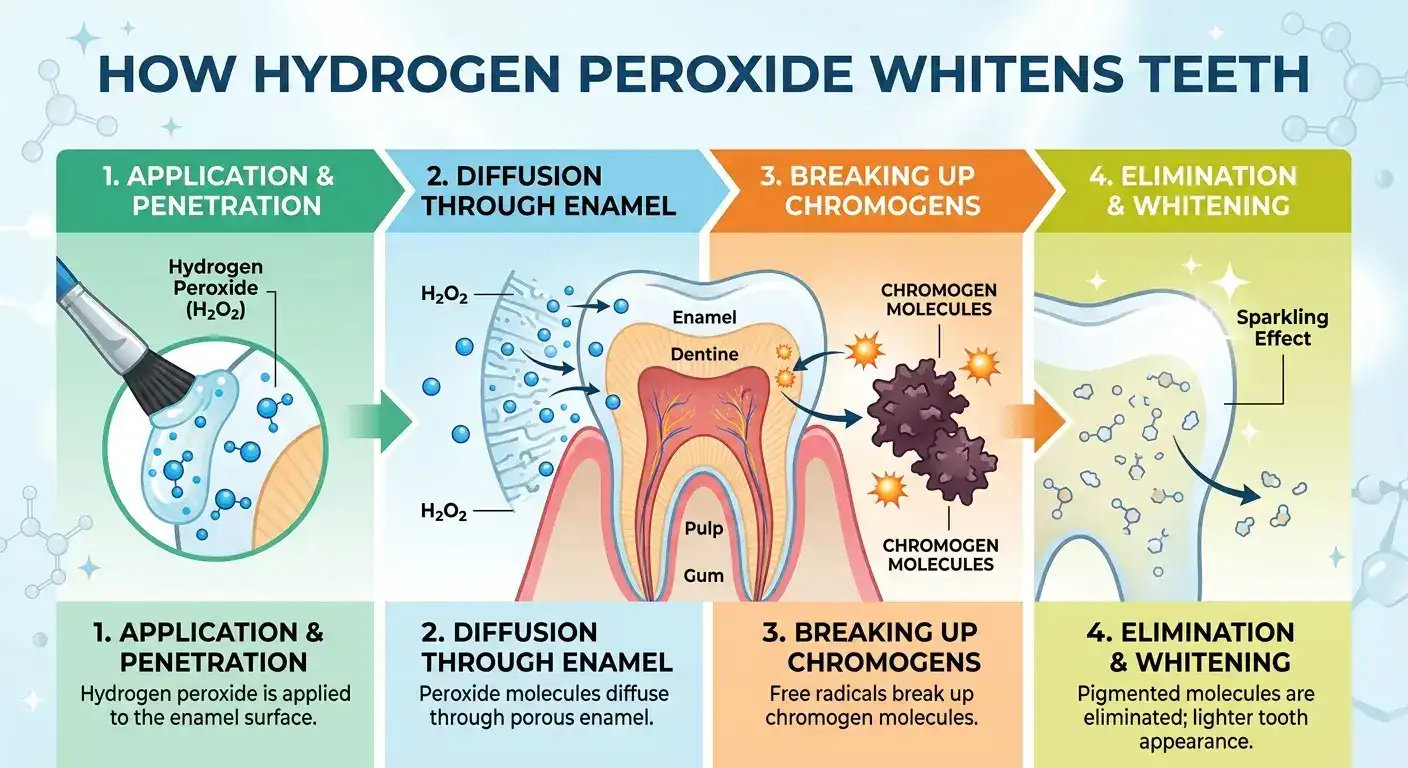
Teeth have a hard outer layer called enamel, which is slightly transparent. Beneath the enamel is dentine, which naturally has a yellowish colour. Over time, coloured compounds from food, drinks, and tobacco can build up in both the enamel and dentine. These coloured compounds are known as chromogens. Hydrogen peroxide is an oxidizing agent. When it comes into contact with the teeth, it breaks down and releases highly reactive molecules called free radicals. These free radicals attack the chromogens and break them into smaller, colorless particles. As these staining molecules lose their colour, the teeth appear whiter.
This process is very different from simply cleaning the surface of the teeth. Whitening toothpastes and abrasive products mainly remove stains from the outside of the enamel. Hydrogen peroxide goes deeper, reaching the dentine and helping to reduce staining from within the tooth structure. This is why it often produces more noticeable and longer-lasting results.
Does Hydrogen Peroxide Really Work?
The answer is yes. A Cochrane Review on tooth whitening found consistent evidence that hydrogen peroxide-based treatments can significantly lighten tooth colour across multiple clinical studies. Among whitening ingredients, hydrogen peroxide has some of the strongest evidence for effectiveness.
The Journal of the American Dental Association (JADA) has also published several studies showing that hydrogen peroxide is effective at whitening teeth in different concentrations and product types. Results typically range from 2–5 shades lighter with consumer products and 5–8 shades lighter with professional in-office treatments.
How much whitening you achieve depends largely on the type of staining and your starting tooth colour:
- Surface stains from food and drinks: Usually respond very well to hydrogen peroxide whitening
- Age-related yellowing: Often responds well because peroxide can reach the dentine where much of the colour change occurs
- Tetracycline staining: More difficult to treat; some improvement is possible, but complete whitening is often not achievable with bleaching alone
- Crowns, veneers, and fillings: These materials do not whiten because peroxide only works on natural tooth structure
Hydrogen Peroxide vs Baking Soda
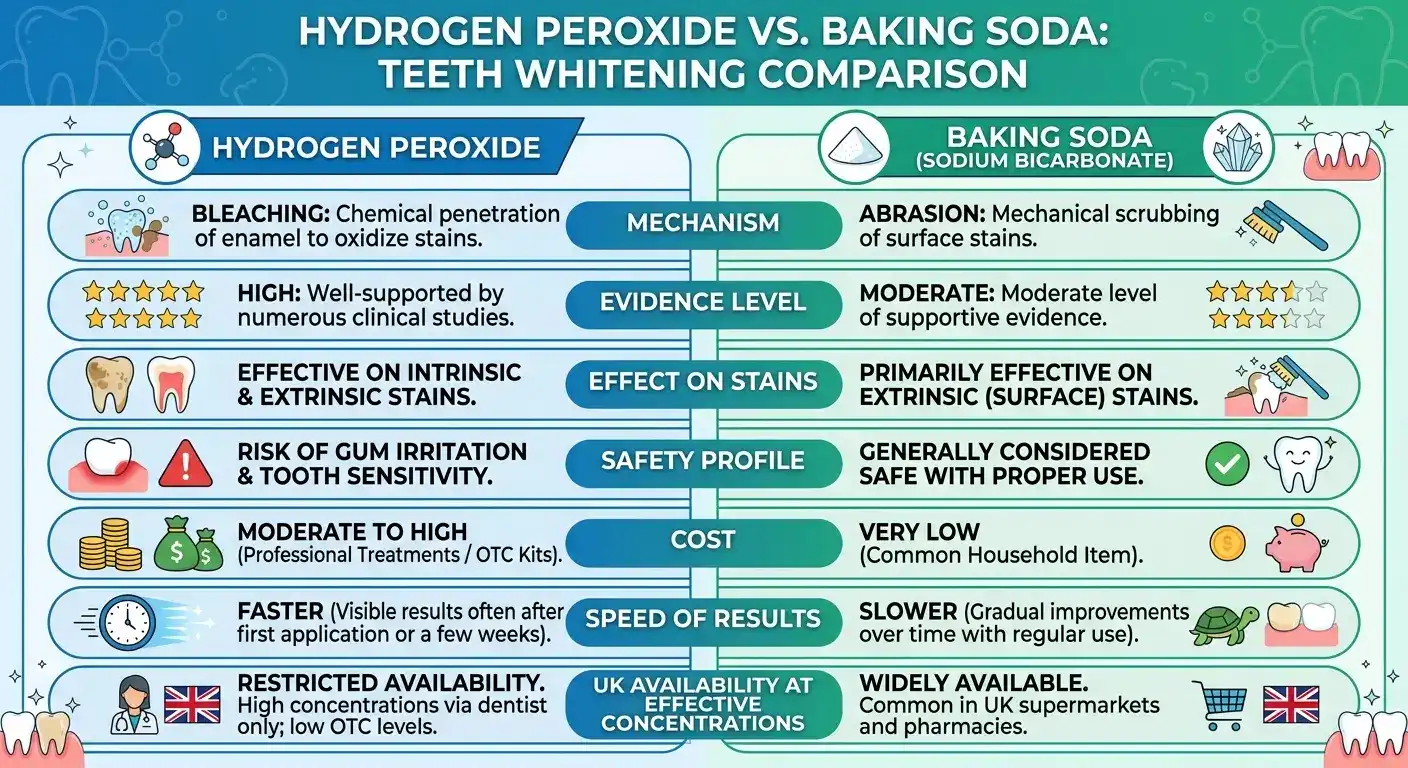
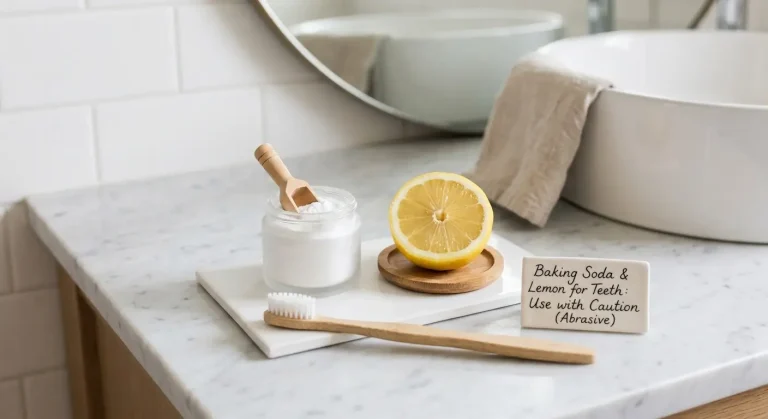
Some whitening toothpastes contain both baking soda and hydrogen peroxide. The baking soda helps remove surface stains, while the peroxide provides deeper bleaching. A study in the Journal of Clinical Dentistry found that whitening toothpastes containing both ingredients performed better than single-ingredient products on several measures of stain removal. Using both ingredients together is reasonable and safe at the concentrations found in toothpaste. The concern changes when someone mixes high-concentration pharmacy peroxide with baking soda into a DIY paste and applies it directly to the teeth.
[→ Internal link: See our guide — [LINK TO BAKING SODA ARTICLE] — for a detailed evidence review of sodium bicarbonate in oral care.]
Is Hydrogen Peroxide Safe for Teeth?
When hydrogen peroxide is used in properly formulated whitening products at the recommended concentrations and according to the instructions, it is considered safe for most adults. The American Dental Association (ADA) states that hydrogen peroxide whitening products can be used safely and effectively when used as directed. The ADA also stresses the importance of following product instructions and seeing a dentist if you already have dental concerns. The NHS recognises hydrogen peroxide-based whitening as an option with evidence of effectiveness. It also advises people to seek dental advice before whitening and notes that products with very high concentrations should only be used under professional supervision. A Cochrane Review on the safety and effectiveness of tooth bleaching found no clinically significant permanent damage to enamel from hydrogen peroxide at the concentrations and contact times used in clinical trials, although temporary sensitivity was common.
The essential safety distinction:
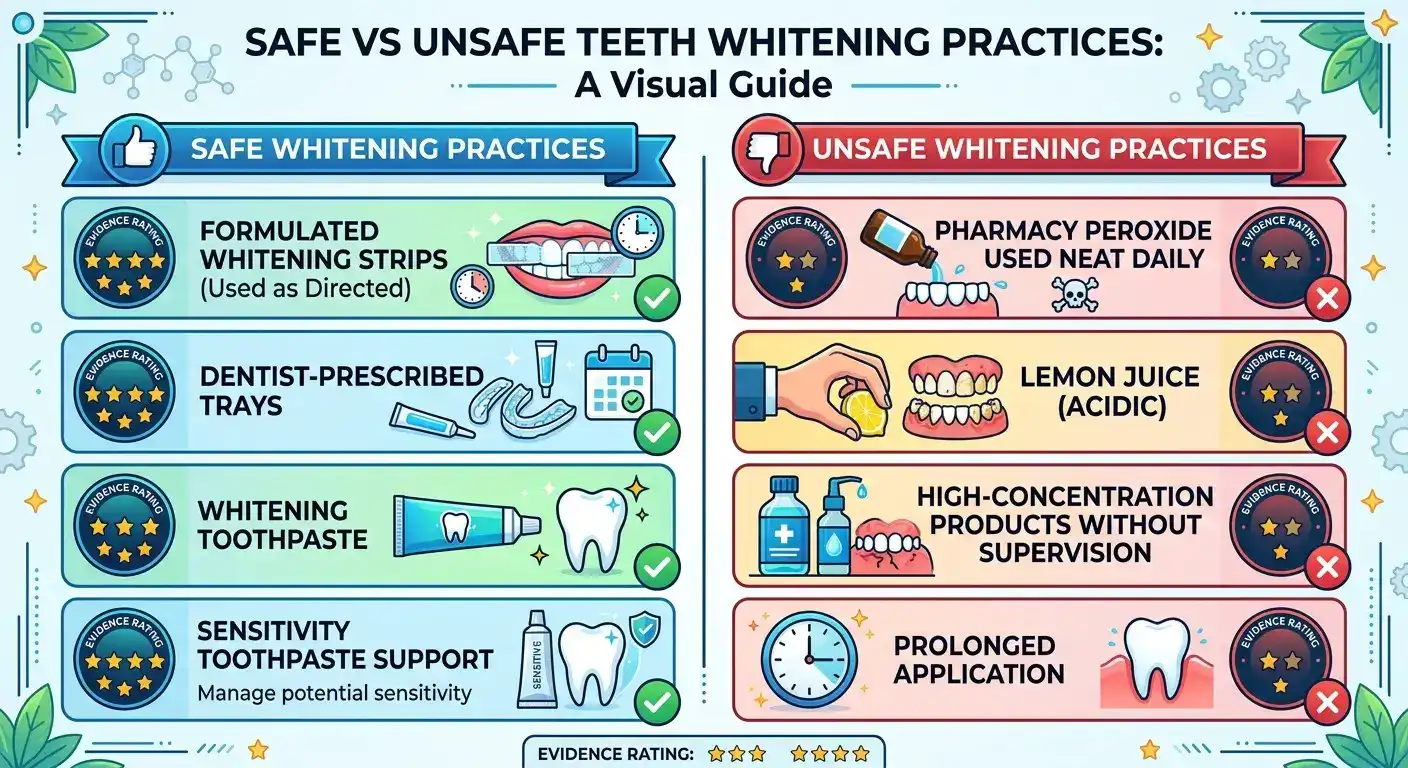
- Formulated whitening products strips, gels, toothpastes that contain hydrogen peroxide at studied concentrations and include stabilising agents: considered safe when used appropriately
- Pharmacy-grade 3% hydrogen peroxide applied directly to teeth or used as a daily mouth rinse: not studied or approved for this use; the contact time, frequency, and lack of formulation controls make it different from clinical whitening products
- High-concentration hydrogen peroxide above 6%, available online from non-dental sources: not safe for consumer use without professional supervision; associated with significant sensitivity and soft tissue damage
Risks and Side Effects
- Tooth sensitivity: Tooth sensitivity is the most commonly reported side effect. Hydrogen peroxide temporarily increases the permeability of enamel, allowing fluid to move through the dentinal tubules, tiny channels that connect the enamel to the dental pulp. These fluid movements stimulate the nerve and can cause sharp, temporary sensitivity to cold, heat, and air. Sensitivity during whitening is usually temporary and goes away within 24–72 hours after treatment is stopped or reduced. It is much more common with higher concentrations and longer contact times.
- Gum irritation: When hydrogen peroxide comes into contact with gum tissue, it can irritate, whitening of the surface tissue, and sometimes pain. Custom-fitted trays provided by a dentist help minimise this by keeping the gel in contact mainly with the teeth. OTC strips should be applied carefully so they do not overlap the gum line.
- Soft tissue damage: At higher concentrations, above 10% hydrogen peroxide, accidental contact with the gums or other oral tissues can cause actual chemical burns, including white patches, ulceration, and significant discomfort. This is why high-concentration products are restricted to professional use.
- Enamel surface changes: Some studies have found temporary changes in the surface hardness of enamel during active bleaching, although these changes usually recover within days to weeks. Current evidence does not support long-term enamel damage from appropriate clinical use. Over-bleaching, doing repeated whitening courses without allowing recovery periods, is a more significant concern.
- Bleach-related stomach irritation: If a meaningful amount of whitening gel is swallowed, which is more likely with older children using gel in OTC trays, it can cause nausea or stomach upset. Following the instructions carefully, including using the recommended amount of gel and not swallowing the product, helps prevent this.
Can Hydrogen Peroxide Remove Yellow Teeth?
For extrinsic staining from coffee, tea, red wine, and tobacco, hydrogen peroxide is highly effective. These staining molecules are found within the enamel and dentine and respond directly to oxidative bleaching. Consistent treatment with an appropriate peroxide-based product can produce clear improvement.
For intrinsic yellowing from ageing, dentine darkening, and enamel thinning, hydrogen peroxide is one of the few agents that can address this type of discolouration. Peroxide passes through the enamel to reach the dentine, where it bleaches chromogens that have built up over the years. The results can be meaningful, although the amount of improvement varies.
For tetracycline staining: Some improvement is possible, but tetracycline becomes incorporated into the tooth structure during development. It is not simply a chromogen that can be oxidised away. Significant whitening of severe tetracycline staining usually requires dental veneers rather than bleaching alone.
For restorations, crowns, fillings, veneers: Hydrogen peroxide bleaches natural tooth enamel only. Ceramic, composite, and other restorative materials do not respond.
[→ Internal link: See our complete guide on — [LINK TO YELLOW TEETH ARTICLE] — for a breakdown of discolouration types and treatments.]
How Long Does It Take to See Visible Results?
| Method | Expected Timeline for Visible Results | Longevity |
|---|---|---|
| OTC whitening strips 0.1% H₂O₂ | 2–4 weeks of daily use | 2–4 months |
| OTC whitening strips 5–14% H₂O₂ | 5–10 days | 3–6 months |
| Dentist-prescribed custom trays 10–22% carbamide peroxide ≈ 3–7% H₂O₂ | 7–14 days of daily use | 6–12 months |
| In-office professional 25–40% H₂O₂ | Single session (60–90 min) | 6–12 months |
| Whitening toothpaste with H₂O₂ | 4–8 weeks of consistent twice-daily use | Maintenance |
How Dentists Use Hydrogen Peroxide
- In-office bleaching: Dentists apply hydrogen peroxide at concentrations of 25–40% to the teeth. Before applying it, the gum tissue is protected with a liquid rubber dam or a special resin barrier. The gel is applied in several applications during the session, with monitoring between applications. Some systems use light or heat to try to speed up the bleaching reaction, although evidence about the specific benefit of light activation beyond the peroxide effect is mixed. The entire procedure takes 60–90 minutes and produces results equivalent to weeks of home whitening.
- Dentist-prescribed home trays: The dentist takes impressions of your teeth and has custom-fitted trays made in a laboratory. You are then given a prescription carbamide peroxide gel. Carbamide peroxide breaks down into hydrogen peroxide and urea in the mouth; a 10% carbamide peroxide product produces approximately 3.5% hydrogen peroxide. The custom fit provides even coverage and helps minimise contact with soft tissues. Concentrations in prescription home-use trays range from 10–22% carbamide peroxide, with lower concentrations used overnight and higher concentrations used for shorter daily sessions. The ADA identifies dentist-supervised home whitening as one of the safest and most effective whitening approaches available, combining professional assessment with the convenience of whitening at home.
Home Whitening Products That Contain Hydrogen Peroxide
Whitening strips (UK market): UK-sold whitening strips are limited to 0.1% hydrogen peroxide by regulation. They can produce results, but usually over a longer period than higher-concentration strips available in other markets. They are one of the most accessible home whitening options.
Whitening gels: These are used with OTC trays or dentist-prescribed custom trays. The gel contains either hydrogen peroxide or carbamide peroxide. For OTC versions, the same concentration limits apply. Custom-tray gels supplied by a dentist operate under prescription rules and can contain higher concentrations.
Whitening toothpastes: Many whitening toothpastes contain very low concentrations of hydrogen peroxide along with abrasive ingredients. At these concentrations, the peroxide contribution to whitening is modest. The main whitening mechanism is usually the abrasive action. Some products contain blue covarine instead, which sticks to the teeth and creates an optical whitening effect rather than chemical bleaching.
Mouthwashes: Some whitening mouthwashes contain hydrogen peroxide. The contact time with the teeth is very short during rinsing, which limits the bleaching effect. They can support general oral hygiene and may help maintain whitening results, but they are not effective as primary whitening treatments.
What Dentists Recommend
The ADA does not recommend using undiluted or partly diluted pharmacy hydrogen peroxide directly on your teeth. Whitening products are tested for safety and effectiveness. Dentists recommend checking for tooth decay, gum disease, and existing dental work before starting any whitening treatment. This isn’t about adding extra cost; it is about avoiding problems that can happen when you use whitening over untreated dental issues. A dentist-made tray combined with a prescription whitening gel usually delivers more reliable and noticeable results than over-the-counter products because the fit is better and the whitening gel is stronger. The type of staining, past medication use, age, and the condition of your enamel all affect how much whitening is possible. A dentist can help you understand what results are realistic before you begin. Some tooth sensitivity is common during whitening. Dentists expect this and usually provide advice on how to manage it before treatment starts.
Best Toothpastes to Support Whitening Maintenance
Optifresh Pro White Toothpaste is designed to help remove everyday surface stains and support a brighter-looking smile with regular brushing. Used twice daily, it helps reduce the build-up of new stains that can dull whitening results over time.
Temporary sensitivity is one of the most common side effects of hydrogen peroxide whitening. Using a sensitivity toothpaste before, during, and after treatment can help reduce discomfort. Optifresh Sensitive Toothpaste provides daily cleaning while helping people who experience tooth sensitivity, whether from whitening treatments or naturally sensitive teeth.
Optifresh Natural Oil Toothpaste supports everyday oral hygiene with natural oil ingredients. It is a good choice for people who prefer a more natural approach to daily brushing. Keeping teeth clean and free from plaque helps maintain whitening results and supports overall oral health.
Foods and drinks that stain teeth can also affect breath freshness. Optifresh Maximum Fresh Toothpaste helps maintain fresh breath as part of a complete oral care routine and works well alongside a whitening process.
Conclusion
Hydrogen peroxide is the science behind effective teeth whitening. The whitening strips, gels, and professional treatments that deliver real results all rely on it. Whitening products are tested, regulated, and designed for dental use. Pharmacy hydrogen peroxide is an antiseptic and is not intended for regular use on teeth or gums. When used correctly in approved whitening products, at suitable concentrations and for the recommended amount of time, hydrogen peroxide is one of the most effective and well-researched whitening ingredients. When used incorrectly, it can cause problems that are often more difficult and expensive to fix than the original tooth staining. If you are considering whitening your teeth, start with a dental consultation. Understanding the cause of your discolouration and choosing the right treatment for it will give you better results, a safer experience, and longer-lasting improvements.
[→ Internal link: See our related guides — [LINK TO TEETH WHITENING GUIDE] | [LINK TO HOME TEETH WHITENING ARTICLE] | [LINK TO TOOTH ENAMEL REPAIR ARTICLE]]