


Home Teeth Whitening: Safe Methods for a Brighter Smile
Home teeth whitening refers to any method you use at home to make your teeth look whiter without visiting a dental clinic for treatment. There are several types of home whitening options, including:
- Whitening strips
- Whitening gels
- Dentist-prescribed take-home whitening trays
- Whitening toothpastes
- Baking soda
- Coconut oil pulling
- Other natural remedies
These methods generally work in two different ways:
Bleaching products use peroxide-based ingredients to lighten the colour of the teeth from within.
Surface stain removers help remove stains that sit on the outside of the enamel but do not change the natural colour of the tooth.
Can You Really Whiten Teeth at Home?
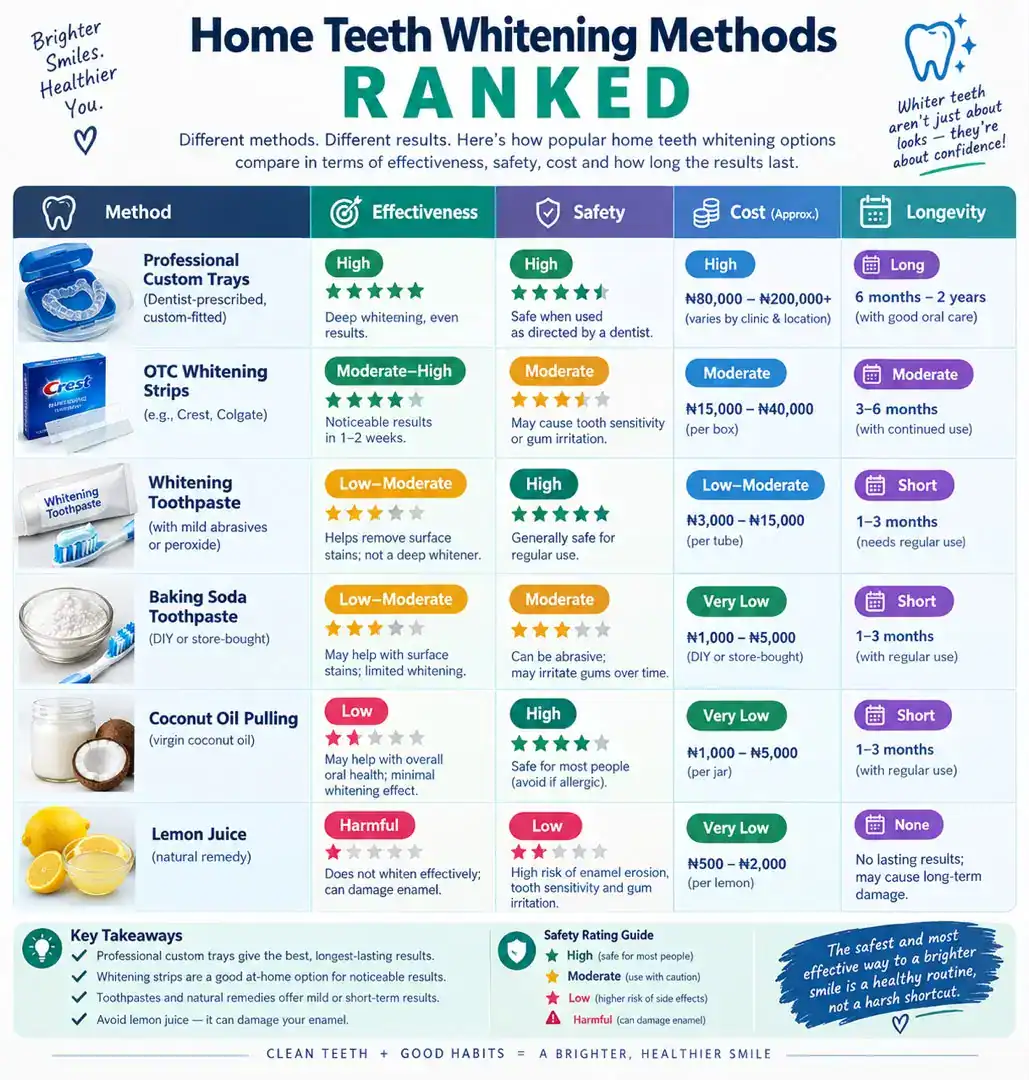
You can whiten your teeth at home, but the results depend on the method you use and what caused the discolouration in the first place. The most effective home whitening options are:
- Dentist-prescribed whitening trays
- Whitening strips that contain hydrogen peroxide
These products use bleaching ingredients that can penetrate the enamel and lighten the tooth from the inside. With regular use, many people see visible results within one to two weeks. What home treatments cannot do is match the speed and precision of professional whitening carried out by a dentist. Professional whitening uses much stronger whitening agents and is carefully monitored to protect the gums and reduce side effects. That does not mean home whitening does not work. It means the results are usually more gradual and may not be as dramatic as professional treatment.
See our complete guide for a full breakdown of all whitening options.
Why Teeth Become Stained
Before choosing a whitening method, it helps to understand why teeth become stained in the first place. There are two main types of tooth discolouration.
Extrinsic Stains
These stains form on the outside of the tooth enamel. Common causes include:
- Coffee
- Tea
- Red wine
- Dark soft drinks
- Tobacco
- Foods with strong colouring
- Poor oral hygiene
Because these stains sit on the surface, they usually respond well to whitening products and professional cleaning.
Intrinsic Stains
These stains develop inside the tooth. Common causes include:
- Ageing
- Certain medications
- Dental injuries
- Fluorosis
As we age, the enamel naturally becomes thinner, allowing more of the yellow dentine underneath to show through. Intrinsic stains are harder to remove and usually require bleaching products that can penetrate the enamel.
See our guide for a full explanation of why teeth discolour and what each type means for treatment.
Home Teeth Whitening Methods That Work
- Whitening Strips
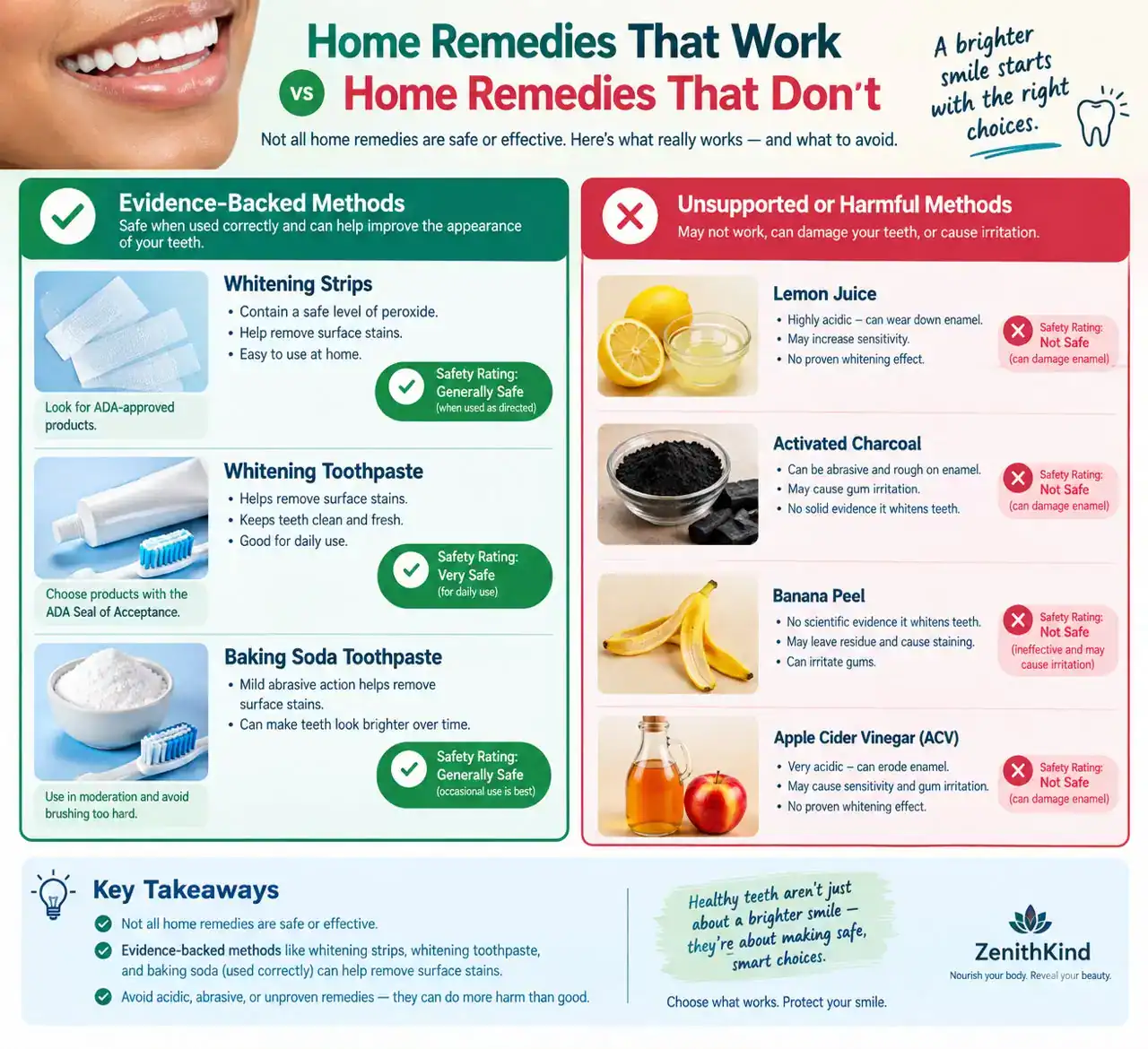
Whitening strips are one of the most popular and effective at-home whitening products. They are thin plastic strips coated with a whitening gel that contains hydrogen peroxide. The peroxide penetrates the enamel and breaks down stain molecules inside the tooth. This lightens the overall colour of the teeth rather than simply cleaning the surface. Studies have consistently shown that whitening strips can make teeth noticeably whiter when used as directed. A review published in the Journal of the American Dental Association found consistent evidence of efficacy across multiple trials. Results of 2–3 shades of lightening over a 10–14-day treatment course are typical.
- Whitening Gels
Whitening gels work in a similar way to whitening strips. They contain hydrogen peroxide or carbamide peroxide and are usually applied using a tray that fits over the teeth. Custom trays provided by a dentist usually give better results than one-size-fits-all trays because they keep the gel in better contact with the teeth.
- Whitening Toothpaste
Whitening toothpaste mainly works by removing surface stains. Most products contain mild polishing ingredients that help lift stains caused by food, drinks, and smoking. Some also contain small amounts of whitening ingredients or optical brighteners that help teeth appear whiter. Whitening toothpastes can help remove surface stains and improve brightness over time. The NHS acknowledges their role in removing surface staining, though notes they cannot change the natural colour of teeth.
- Dentist-Prescribed Home Whitening Trays
This is considered the most effective home whitening method. A dentist takes impressions of your teeth and creates trays that fit perfectly. You then use a whitening gel inside the trays at home for a specified period each day. The custom fit keeps the gel in close contact with the teeth and reduces irritation to the gums. Many people achieve results similar to professional in-office whitening after one to two weeks of use. The American Dental Association considers dentist-supervised tray whitening one of the safest and most effective whitening options available.
Home Teeth Whitening Methods
- Coconut Oil Pulling
Oil pulling is an old Ayurvedic practice that involves swishing oil around your mouth for 10–20 minutes before spitting it out. Traditionally, people used sesame oil, but coconut oil is now more common. The idea behind oil pulling is that the oil helps remove bacteria and toxins from the mouth. Some small studies have found that oil pulling may reduce plaque and certain bacteria linked to gum disease. One study published in the Journal of the Indian Society of Pedodontics and Preventive Dentistry found that coconut oil pulling reduced Streptococcus mutans (a bacterium linked to tooth decay) after 30 days.
When it comes to whitening teeth, however, the evidence is very limited. Any improvement in stains is likely due to the swishing action itself rather than the oil. In other words, it may work much like rinsing with water. Coconut oil contains lauric acid, which has antibacterial properties and may support overall oral health, but there are currently no peer-reviewed randomised controlled trials showing that oil pulling can significantly whiten teeth.
[→ Internal link: See our related guide — [LINK TO BAKING SODA ARTICLE] — for a comparison of natural whitening methods.]
- Baking Soda (Sodium Bicarbonate)
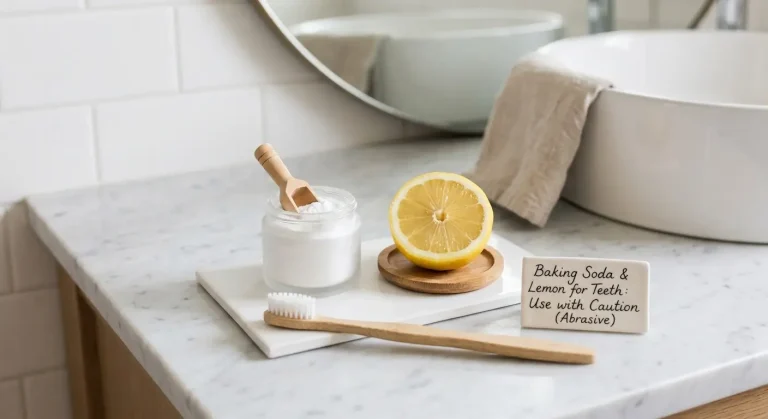
Baking soda is different from many other home whitening remedies because there is real evidence supporting its ability to remove surface stains. Baking soda is a mild abrasive that helps polish the surface of the teeth and lift stains. The American Dental Association (ADA) recognises sodium bicarbonate as a safe and effective ingredient in toothpaste for cleaning teeth and removing surface stains. Several studies comparing baking soda toothpastes with regular toothpastes have shown that baking soda performs better at removing surface stains.
However, baking soda does not bleach teeth. It can remove stains from the surface, but it does not change the natural colour of the dentine inside the tooth. Using baking soda as a thick paste too often may also wear down enamel over time. Commercial toothpastes are carefully formulated to balance cleaning power with safety.
Home Teeth Whitening Methods That Can Damage Teeth
- Lemon Juice and Citric Acid
Lemon juice is highly acidic, with a pH of around 2, which is similar to stomach acid. When applied to teeth, it softens and removes minerals from the enamel. Some people think their teeth look whiter afterward, but this is not true whitening. What is actually happening is that the acid is wearing away a thin layer of enamel. Enamel does not grow back. Once it is lost, it is gone forever.
Regularly applying lemon juice to your teeth can:
- Thin the enamel
- Increase tooth sensitivity
- Increase the risk of cavities
- Make teeth appear more yellow over time because more dentine becomes visible
The NHS specifically warns against using acidic foods and drinks in this way.
- Apple Cider Vinegar
Apple cider vinegar has the same problem as lemon juice. It is highly acidic, with a pH of around 2–3. Although it is often promoted online for different health benefits, there is no reliable evidence that it whitens teeth. There is, however, evidence that it can damage enamel.
- Activated Charcoal
Activated charcoal toothpastes and powders are often advertised as natural teeth whiteners, but the evidence does not support many of the claims. The ADA states that there is not enough clinical evidence to confirm that activated charcoal is safe or effective for whitening teeth. Some concerns include:
- It may be abrasive and wear down enamel over time
- Charcoal particles can collect between teeth and along the gum line
- Many charcoal products do not contain fluoride, which helps protect teeth from decay
- No strong clinical trials are showing meaningful whitening results
- Banana Peels
Some people claim that rubbing banana peels on teeth can whiten them because they contain minerals such as potassium and magnesium. However, there is no clinical evidence to support this claim. Research published in Operative Dentistry found no significant whitening effect from using banana peels.
- Hydrogen Peroxide Used on Its Own
Hydrogen peroxide deserves special attention because it sits somewhere between “effective” and “potentially harmful. Hydrogen peroxide is the main active ingredient in professional and over-the-counter whitening products. When used in the correct concentration and in properly formulated products, it is one of the most effective teeth whitening ingredients.
However, using plain 3% hydrogen peroxide from the pharmacy directly on your teeth is not the same thing. When used incorrectly, too often, for too long, or at the wrong concentration, hydrogen peroxide can cause:
- Tooth sensitivity
- Gum irritation
- Damage to tooth enamel
Baking Soda vs Hydrogen Peroxide
These are the two home whitening ingredients with the strongest evidence behind them. However, they work in very different ways.
| Feature | Baking Soda | Hydrogen Peroxide |
|---|---|---|
| How it works | Mild abrasive that removes surface stains | Bleaching agent that lightens tooth colour |
| Evidence | Strong for removing surface stains | Strong for whitening teeth |
| Changes natural tooth colour? | No | Yes |
| Risk if overused | Enamel wear from abrasion | Sensitivity and irritation |
| Found in | Whitening toothpastes | Whitening strips, gels, and professional products |
| Best for | Daily stain removal and maintenance | Actual whitening and shade improvement |
| UK consumer limit | No limit in toothpaste | 0.1% in OTC products |
Baking soda helps remove stains from the surface. Hydrogen peroxide actually whitens the teeth. If you want noticeable whitening, peroxide-based products are usually needed. Baking soda can help, but it cannot do the same job.
Is Home Teeth Whitening Safe?
For most people, home teeth whitening is safe when the products are used correctly and according to the instructions. The Mayo Clinic explains that when whitening products are used properly, they do not damage tooth enamel. However, overusing them or using products with very high concentrations can lead to temporary sensitivity and changes to the enamel surface.
Leaving whitening strips on your teeth longer than recommended will not make them work faster. Instead, it increases the risk of irritation and sensitivity. Using several whitening methods at the same time, such as whitening strips, whitening toothpaste, and baking soda scrubs, can also increase the amount of abrasion and peroxide exposure beyond what has been tested for safety.
A Cochrane Review found that hydrogen peroxide-based whitening products, when used as recommended, do not cause clinically significant damage to tooth enamel.
Products That Support a Brighter, Healthier Smile
The right toothpaste can help maintain whitening results and support overall oral health.
Optifresh Pro White Toothpaste helps remove everyday surface stains and supports a brighter-looking smile when used as part of your daily brushing routine. It can also help reduce the buildup of new stains.
If whitening treatments make your teeth sensitive, Optifresh Sensitive Toothpaste can help reduce discomfort while keeping your teeth clean and healthy.
Optifresh Natural Oil Toothpaste provides everyday oral care using a natural oil-based formula. Keeping teeth clean and plaque-free is an important part of maintaining a bright smile.
Many foods and drinks that stain teeth can also affect breath. Optifresh Maximum Fresh Toothpaste helps keep your mouth feeling clean and fresh as part of your daily routine.
Conclusion
Home teeth whitening can work very well when you choose methods that are supported by real evidence. The challenge is knowing the difference between proven whitening methods and popular online trends. The most effective home options are peroxide-based whitening products, especially dentist-prescribed custom trays and whitening strips. On the other hand, many viral remedies either do not work or may damage your teeth.
For most people, the best approach is to combine good daily oral hygiene with a safe whitening method that fits their needs. Limiting coffee, tea, red wine, and tobacco can also help keep teeth brighter for longer.
See our guides: TEETH WHITENING GUIDE| YELLOW TEETH ARTICLE | [LINK TO TOOTH ENAMEL REPAIR ARTICLE]]